2025-11-20 ピッツバーグ大学
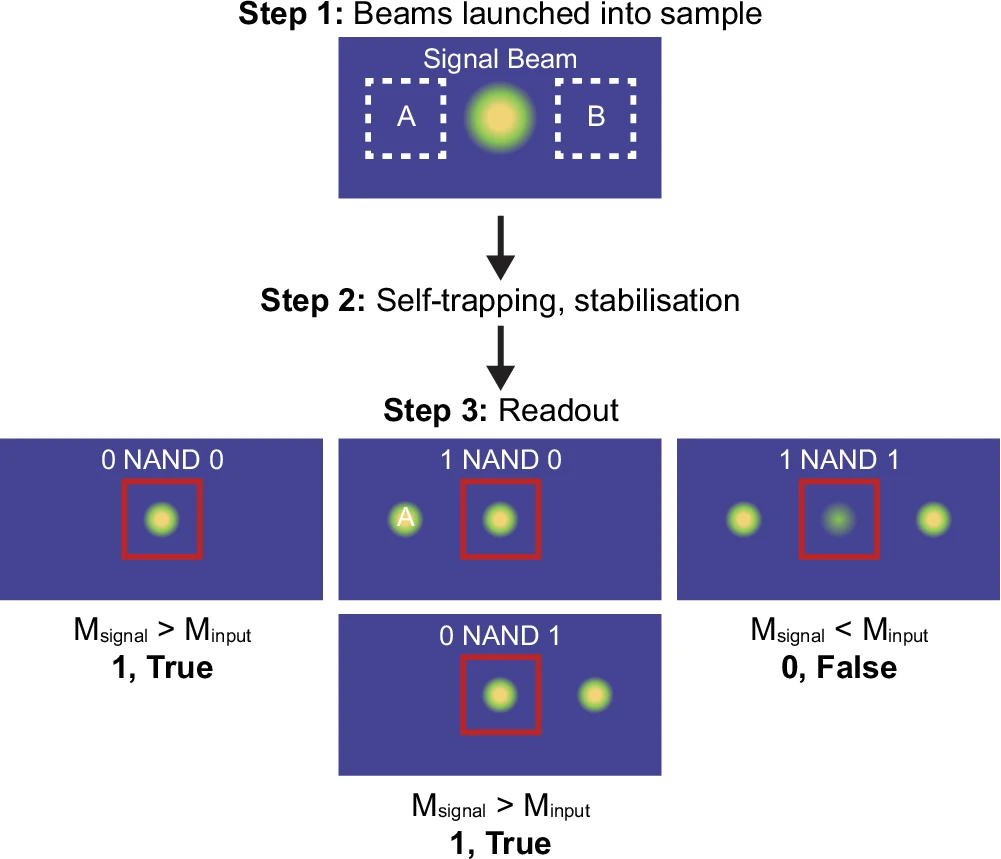
Above: A central signal beam is always launched into the sample. Inputs A (MA) and B (MB) may be on or off. After the beams equilibrate, the final intensity profile is used to determine the output. False is only obtained when the output signal is affected by interactions with two neighboring beams. For 1 NAND 1, the output signal results from mutual interactions between Beams 1 and 3, and thus, the NAND response is false.
<関連情報>
- https://news.engineering.pitt.edu/from-light-to-logic
- https://www.nature.com/articles/s41467-025-64960-4
- https://www.science.org/doi/10.1126/sciadv.1601114
- https://www.nature.com/articles/srep11577
柔らかい光応答性ハイドロゲルにおける機能的に完全な論理ゲート A functionally complete logic gate in a soft photoresponsive hydrogel
Fariha Mahmood,Victor V. Yashin,Anna C. Balazs & Kalaichelvi Saravanamuttu
Nature Communications Published:14 November 2025
DOI:https://doi.org/10.1038/s41467-025-64960-4
Abstract
Materials that compute—or process stimuli to generate a result output—are important in applications ranging from soft robotics to therapeutics. Here, we report a NAND gate based on the interactions of three self-trapped beams in a photoresponsive hydrogel. The beams self-trap by triggering localised contraction and corresponding refractive index changes (Δn) and communicate with each other through the interconnected hydrogel network. Light-induced Δn in one region suppresses contraction (and Δn) elsewhere. This inhibits self-trapping and reduces the power of the central beam—which competes with two equidistant neighbours—compared to either peripheral beam, which competes with just one neighbour. The NAND gate exploits this geometry-dependent inhibition: the central beam’s peak power—the output—exceeds a threshold value unless both neighbours—inputs—are on, i.e., an output = 0 is retrieved only with input [1, 1]. We then demonstrate two and, separately, twelve sequentially chained NAND operations, and propose a route to multiple, simultaneously linked operations in a single, internally mediated step. Here, the output from one operation is spontaneously directed to subsequent operations. Our findings open pathways to soft materials with autonomous computational functionality.
「計算する材料」によるパターン認識 Pattern recognition with “materials that compute”
Yan Fang https://orcid.org/0000-0002-5416-3302, Victor V. Yashin, Steven P. Levitan, and Anna C. Balazs
Science Advances Published:2 Sep 2016
DOI:https://doi.org/10.1126/sciadv.1601114
Abstract
Driven by advances in materials and computer science, researchers are attempting to design systems where the computer and material are one and the same entity. Using theoretical and computational modeling, we design a hybrid material system that can autonomously transduce chemical, mechanical, and electrical energy to perform a computational task in a self-organized manner, without the need for external electrical power sources. Each unit in this system integrates a self-oscillating gel, which undergoes the Belousov-Zhabotinsky (BZ) reaction, with an overlaying piezoelectric (PZ) cantilever. The chemomechanical oscillations of the BZ gels deflect the PZ layer, which consequently generates a voltage across the material. When these BZ-PZ units are connected in series by electrical wires, the oscillations of these units become synchronized across the network, where the mode of synchronization depends on the polarity of the PZ. We show that the network of coupled, synchronizing BZ-PZ oscillators can perform pattern recognition. The “stored” patterns are set of polarities of the individual BZ-PZ units, and the “input” patterns are coded through the initial phase of the oscillations imposed on these units. The results of the modeling show that the input pattern closest to the stored pattern exhibits the fastest convergence time to stable synchronization behavior. In this way, networks of coupled BZ-PZ oscillators achieve pattern recognition. Further, we show that the convergence time to stable synchronization provides a robust measure of the degree of match between the input and stored patterns. Through these studies, we establish experimentally realizable design rules for creating “materials that compute.”
アクティブハイブリッド材料による同期の実現:自励振動ゲルと圧電フィルムの結合 Achieving synchronization with active hybrid materials: Coupling self-oscillating gels and piezoelectric films
Victor V. Yashin,Steven P. Levitan & Anna C. Balazs
Scientific Reports Published:24 June 2015
DOI:https://doi.org/10.1038/srep11577
Abstract
Lightweight, deformable materials that can sense and respond to human touch and motion can be the basis of future wearable computers, where the material itself will be capable of performing computations. To facilitate the creation of “materials that compute”, we draw from two emerging modalities for computation: chemical computing, which relies on reaction-diffusion mechanisms to perform operations and oscillatory computing, which performs pattern recognition through synchronization of coupled oscillators. Chemical computing systems, however, suffer from the fact that the reacting species are coupled only locally; the coupling is limited by diffusion as the chemical waves propagate throughout the system. Additionally, oscillatory computing systems have not utilized a potentially wearable material. To address both these limitations, we develop the first model for coupling self-oscillating polymer gels to a piezoelectric (PZ) micro-electro-mechanical system (MEMS). The resulting transduction between chemo-mechanical and electrical energy creates signals that can be propagated quickly over long distances and thus, permits remote, non-diffusively coupled oscillators to communicate and synchronize. Moreover, the oscillators can be organized into arbitrary topologies because the electrical connections lift the limitations of diffusive coupling. Using our model, we predict the synchronization behavior that can be used for computational tasks, ultimately enabling “materials that compute”.