2025-10-28 イリノイ大学アーバナ・シャンペーン校
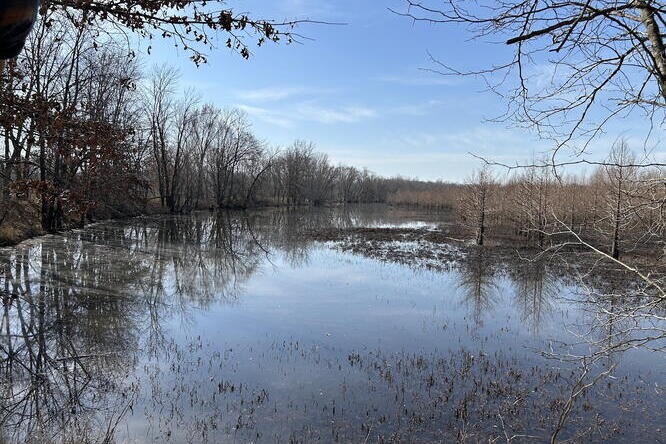
A wetland in the Agricultural Conservation Easement Program in Illinois.
<関連情報>
- https://aces.illinois.edu/news/wetlands-efficiently-remove-nitrogen-pollution-surface-water-leading-cost-savings
- https://www.journals.uchicago.edu/doi/10.1086/739287
自然の腎臓:水質回復における湿地保護区地役権の役割 Nature’s Kidneys: the Role of Wetland Reserve Easements in Restoring Water Quality
Nicole Karwowski and Marin Skidmore
Journal of the Association of Environmental and Resource Economists April 2025
Abstract
Billions of dollars have been dedicated to mitigating non-point source pollutionfrom US agriculture. Wetlands provide an ex-post natural solution by filtering sed-iments and excess nutrients from the landscape. Quantifying the impact of wetlandeasements in the Wetland Reserve Program (WRP) and Agricultural ConservationEasement Program (ACEP) on water quality is critical for optimal fund allocationfor non-point source pollution abatement. We causally identify whether newly re-stored wetlands reduce nitrogen and phosphorus loads at the subwatershed levelin the Mississippi River Basin. Results show that wetland easements reduce am-monia and total Kjeldahl nitrogen concentrations in the local subwatershed as wellas downstream. A short-term increase in local phosphorus immediately followingrestoration likely reflects soil disturbance. While wetlands have no significant long-term impact on local phosphorus levels, downstream reductions are observed. Weestimate that this federal investment in natural infrastructure leads to lower treat-ment costs for local water systems.