2025-10-23 マサチューセッツ工科大学 (MIT)
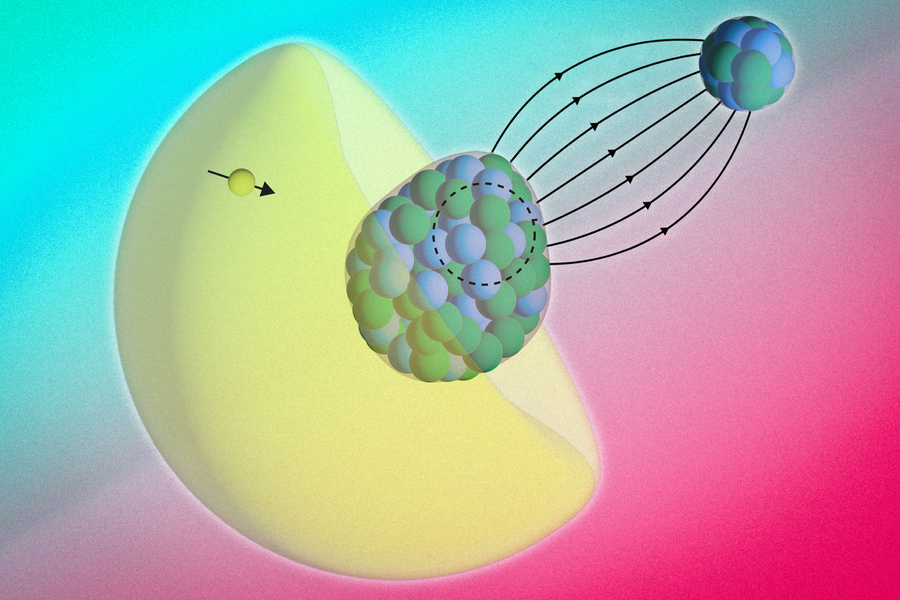
This image depicts the radium atom’s pear-shaped nucleus of protons and neutrons in the center, surrounded by a cloud of electrons (yellow), and an electron (yellow ball with arrow) that has a probability to be inside the nucleus. In the background is the spherical nucleus of a fluoride atom, which joins to form the overall molecule of radium monofluoride.Credits:Image: Courtesy of the researchers; edited by MIT News
<関連情報>
- https://news.mit.edu/2025/new-molecule-based-method-physicists-peer-inside-atoms-nucleus-1023
- https://www.science.org/doi/10.1126/science.adm7717
分子内の核磁化分布の観察 Observation of the distribution of nuclear magnetization in a molecule
S. G. Wilkins, S. M. Udrescu, M. Athanasakis-Kaklamanakis, R. F. Garcia Ruiz, […] , and C. Zülch
Science Published:23 Oct 2025
DOI:https://doi.org/10.1126/science.adm7717
Editor’s summary
Precision molecular spectroscopy is increasingly being used to probe symmetry violations relevant to fundamental physics studies. Of particular interest are molecules containing heavy radioactive nuclei, such as the pear-shaped radium isotope 225Ra. Wilkins et al. performed laser spectroscopy measurements of the hyperfine structure of the radium monofluoride molecule, which is especially challenging given the molecule’s short lifetime. In combination with calculations, the researchers were able to test models of magnetization distribution inside the radium nucleus. Their findings may lead to improved tests of fundamental symmetries. —Jelena Stajic
Abstract
Precise experimental control and interrogation of molecules and calculations of their structure are enriching the investigation of nuclear and particle physics phenomena. Molecules containing heavy, octupole-deformed nuclei, such as radium, are of particular interest. Here, we report precision laser spectroscopy measurements and theoretical calculations of the structure of the radioactive radium monofluoride molecule 225Ra19F. Our results reveal fine details of the short-range electron-nucleus interaction, indicating the high sensitivity of this molecule to the distribution of magnetization, within the radium nucleus. These results provide a stringent test of the description of the electronic wave function inside the nuclear volume, highlighting the suitability of these molecules for investigating subatomic phenomena.