2025-10-24 シカゴ大学
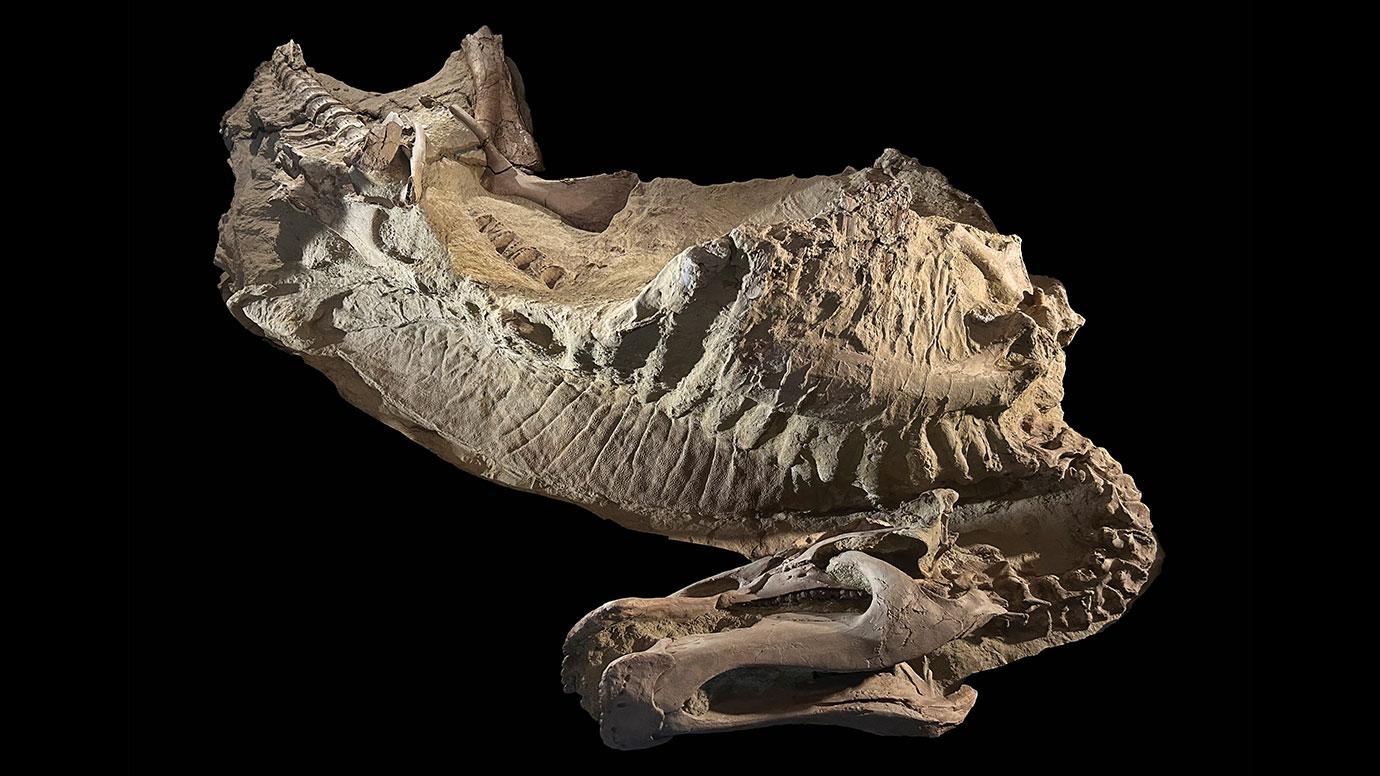 A mummy of the juvenile duck-billed dinosaur Edmontosaurus annectens was preserved as a dried carcass some 66 million years ago in the badlands of Wyoming. Large areas of scaly, wrinkled skin and a tall, fleshy crest over its back were preserved in a thin layer of clay over its fossilized skeleton.Photo courtesy of Tyler Keillor/Fossil Lab
<関連情報>
- https://news.uchicago.edu/story/uchicago-paleontologists-unveil-duck-billed-dinosaur-mummies
- https://www.science.org/doi/10.1126/science.adw3536
アヒルの嘴を持つ恐竜の肉厚な正中線と蹄から、陸上の粘土鋳型による「ミイラ化」が明らかになった Duck-billed dinosaur fleshy midline and hooves reveal terrestrial clay-template “mummification”
Paul C. Sereno, Evan T. Saitta, Daniel Vidal, Nathan Myhrvold, […] , and Kraig Derstler
Science Published:23 Oct 2025
DOI:https://doi.org/10.1126/science.adw3536
Abstract
Two “mummies” of the end-Cretaceous, duck-billed dinosaur Edmontosaurus annectens preserve a fleshy crest over the neck and trunk, an interdigitating spike row over the hips and tail, and hooves capping the toes of the hind feet. A battery of tests shows that all the fossilized integument (skin, spike, hoof) are preserved as a thin (< 1mm) clay template that formed on the surface of a buried carcass during decay prior to loss of all soft tissues and organic compounds. Unlike the underlying permineralized skeletal bone, the integument renderings of these “dinosaur mummies” are preserved as a thin external clay mask, a templating process documented previously only in anoxic marine settings.