2025-10-23 チャルマース工科大学
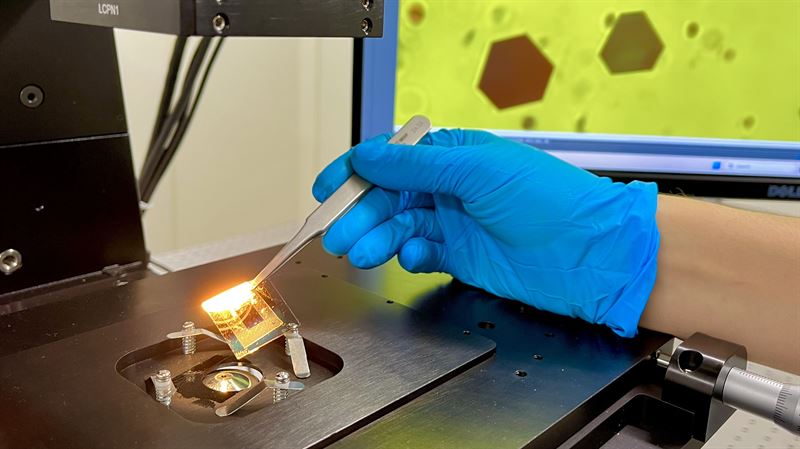
When dust sticks to a surface or a lizard sits on a ceiling, it is due to ‘nature’s invisible glue’. Researchers at Chalmers University of Technology, Sweden, have now discovered a quick and easy way to study the hidden forces that bind the smallest objects in the universe together. Using gold, salt water and light, they have created a platform on which the forces can be seen through colours.
<関連情報>
- https://news.cision.com/chalmers/r/a-platform-of-gold-reveals-the-forces-of-nature-s-invisible-glue,c4254987
- https://www.pnas.org/doi/10.1073/pnas.2505144122
- https://www.nature.com/articles/s41586-021-03826-3
カシミール自己組織化:液体中のナノスケール表面相互作用を測定するためのプラットフォーム Casimir self-assembly: A platform for measuring nanoscale surface interactions in liquids
Michaela Hošková, Oleg V. Kotov, Betül Küçüköz, +1 , and Timur O. Shegai
Proceedings of the National Academy of Sciences Published:August 1, 2025
DOI:https://doi.org/10.1073/pnas.2505144122
Significance
From the natural formation of membranes to the design of advanced materials, self-assembly is fundamental to both living and nonliving systems. However, understanding the forces governing these dynamics, particularly at planar interfaces, remains challenging. Traditional methods often rely on ensemble-averaged measurements, limiting insights into single-particle interactions. To address this, we introduce Casimir self-assembly (CaSA) as a platform that utilizes thermal fluctuations to study the interaction potential in situ. This approach provides precise measurements of zeta potential and surface charge density, key factors in colloidal stability. CaSA overcomes limitations of ensemble methods, offering insight into self-assembly forces. Its sensitivity to ionic conditions enables detection of concentration changes, relevant for sensing, and its responsiveness opens possibilities for feedback-controlled microfluidic systems.
Abstract
Self-assembly (SA) plays a pivotal role in nanotechnology, offering cost-effective methods for bottom–up fabrication and providing versatile model systems for investigating fundamental interactions in various bioinspired systems. However, current methods for investigating and quantifying the dynamics of SA systems are limited in their applicability to planar interfaces, particularly in liquid environments. These methods typically rely on analyzing the collective behavior of particle suspensions rather than directly probing the specific interactions between individual particles. Here, we introduce Casimir self-assembly (CaSA) as a platform, integrating colloidal science, nanophotonics, and fluctuational electrodynamics to study long-range interactions and stability in planar SA systems. Using thermal fluctuations as a probe and visible-range Fabry–Pérot resonances as an optical readout, we demonstrate that CaSA enables a direct in situ study of the Casimir–Lifshitz electrostatic interaction. This approach allows us to map stability regimes of colloidal materials by varying ionic strength and identifying conditions for stable assembly and aggregation limits, and moreover is used to measure the surface charge density of an individual colloidal object down to fractions of an electron charge per square nanometer. Our platform overcomes the limitations of current methods, providing an experimental tool for exploring SA dynamics in situ and expanding the understanding of suspension stability in liquids at the single-particle level. With potential for future applications, CaSA is scalable for studying interfacial forces and is adaptable to multivalent electrolytes and biosensing.
調整可能な自己組織化カシミール微小共振器とポラリトン Tunable self-assembled Casimir microcavities and polaritons
Battulga Munkhbat,Adriana Canales,Betül Küçüköz,Denis G. Baranov & Timur O. Shegai
Nature Publishe:d08 September 2021
DOI:https://doi.org/10.1038/s41586-021-03826-3
Abstract
Spontaneous formation of ordered structures—self-assembly—is ubiquitous in nature and observed on different length scales, ranging from atomic and molecular systems to micrometre-scale objects and living matter1. Self-ordering in molecular and biological systems typically involves short-range hydrophobic and van der Waals interactions2,3. Here we introduce an approach to micrometre-scale self-assembly based on the joint action of attractive Casimir and repulsive electrostatic forces arising between charged metallic nanoflakes in an aqueous solution. This system forms a self-assembled optical Fabry–Pérot microcavity with a fundamental mode in the visible range (long-range separation distance about 100–200 nanometres) and a tunable equilibrium configuration. Furthermore, by placing an excitonic material in the microcavity region, we are able to realize hybrid light–matter states (polaritons4,5,6), whose properties, such as coupling strength and eigenstate composition, can be controlled in real time by the concentration of ligand molecules in the solution and light pressure. These Casimir microcavities could find future use as sensitive and tunable platforms for a variety of applications, including opto-mechanics7, nanomachinery8 and cavity-induced polaritonic chemistry9.