2025-10-21 コロンビア大学
Web要約 の発言:
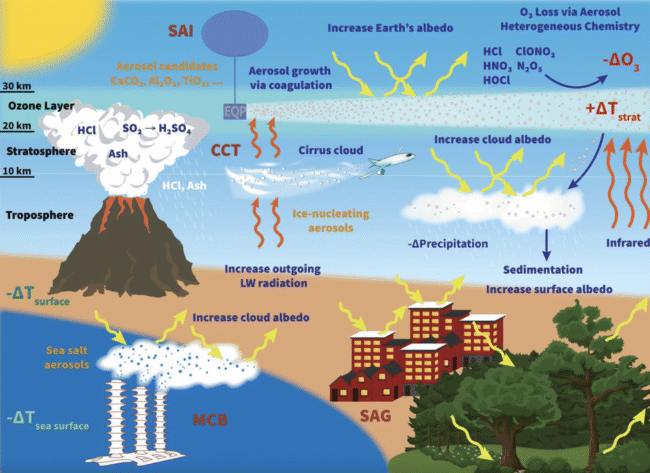
An illustration of climate geoengineering techniques, including stratospheric aerosol injection (SAI), cirrus cloud thinning (CCT), and marine cloud brightening (MCB), and their proposed delivery systems and potential impacts. Natural stratospheric aerosol release from a volcanic eruption is also shown for context. Surface albedo geoengineering (SAG), which is based on increasing the albedo of various surfaces, is also represented with two examples: installing white roofs on urban buildings and modifying plants and shrubs surface. Licensed under Creative Commons.
<関連情報>
- https://news.climate.columbia.edu/2025/10/21/how-hard-is-it-to-dim-the-sun/
- https://www.nature.com/articles/s41598-025-20447-2
工学的および物流上の懸念により、成層圏エアロゾル注入戦略には実際的な制限が加わる Engineering and logistical concerns add practical limitations to stratospheric aerosol injection strategies
Miranda Hack,V. Faye McNeill,Dan Steingart & Gernot Wagner
Scientific Reports Published:21 October 2025
DOI:https://doi.org/10.1038/s41598-025-20447-2
Abstract
The use of reflective aerosols in the upper atmosphere (stratospheric aerosol injections, SAI) to limit incoming sunlight has been proposed as a potential means of countering anthropogenic climate change. Such a strategy ideates from observed cooling effects due to sulfate aerosol formation following volcanic eruptions. Solid mineral candidates have been proposed as a sulfate alternative, potentially lowering environmental risks like ozone depletion and absorption of radiation. The bulk of SAI modeling literature focuses on optimal deployment scenarios, in which practical constraints—microphysical, geopolitical, and economic—are not considered. Here, we explore several key micro- and macroscopic aspects of deployment that may directly increase risk, and the degree to which technical and governance approaches could be levied to offset it. We find that the risk and design space for SAI may be considerably constrained by factors like supply chains and governance. Logistical and technical considerations, most significantly difficulties in dispersing solid aerosols at scale in the desired size range, and the radiative properties of potentially formed aggregates, notably introduce uncertainties in the outcomes of solid-based SAI strategies more so than sulfate. We conclude that the design space for a “low-risk” SAI strategy, particularly with solid aerosol, may be more limited than current literature reflects.