
2025-10-20 ピッツバーグ大学
<関連情報>
- https://news.engineering.pitt.edu/hitting-a-nerve
- https://academic.oup.com/pnasnexus/advance-article/doi/10.1093/pnasnexus/pgaf330/8287403
反応ネットワークにおける化学シグナル伝達は対応する機械的インパルスを生成する Chemical signaling in reaction networks generates corresponding mechanical impulses
Oleg E Shklyaev, Anna C Balazs
PNAS Nexus Published:16 October 2025
DOI:https://doi.org/10.1093/pnasnexus/pgaf330
Abstract
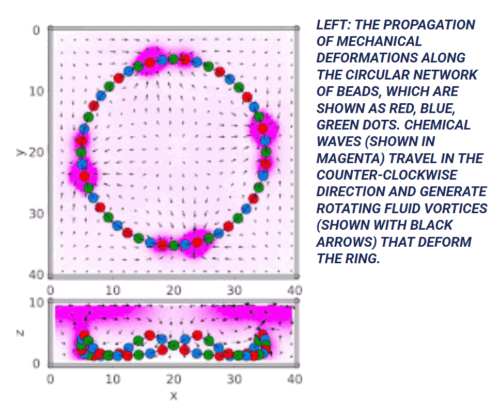
Chemical reaction networks (CRN) in the body are directed pathways that transmit reagents to reactive sites and trigger chemical processes, which ultimately instigate the appropriate physical activity. Typically, models for CRNs do not describe the coupling among chemistry, hydrodynamics and fluid-structure interactions that inherently arise in fluids. Herein, we develop a model that describes the above interrelated physicochemical behavior and show that chemical transport in a CRN spontaneously gives rise to transduction of chemistry into mechanical work, to form a complementary chemo-mechanical network (CMN). To simulate CRNs, we use the repressilator model, a reaction pathway involving biomimetic feedback loops. The encompassing material system is formed from an ordered array of enzyme-coated beads that are interlinked to form a flexible network. Coupling of chemistry and hydrodynamics occurs through the solutal buoyancy mechanism where variations in chemical concentration drive the fluid motion that deforms the flexible network of beads. Consequently, this system displays chemo-mechanical transduction as chemical signals in the CRN are converted to mechanical action. Using this model, we design materials systems encompassing CRNs that spontaneously generate CMNs, which perform the mechanical work of transporting particles or morphing the structure of the elastic network. The propagation of chemical signals along CMN that lead to mechanical actions mimic a nervous system, which transmits signals that instruct a responsive musculature.


