2025-10-13 シンガポール国立大学 (NUS)
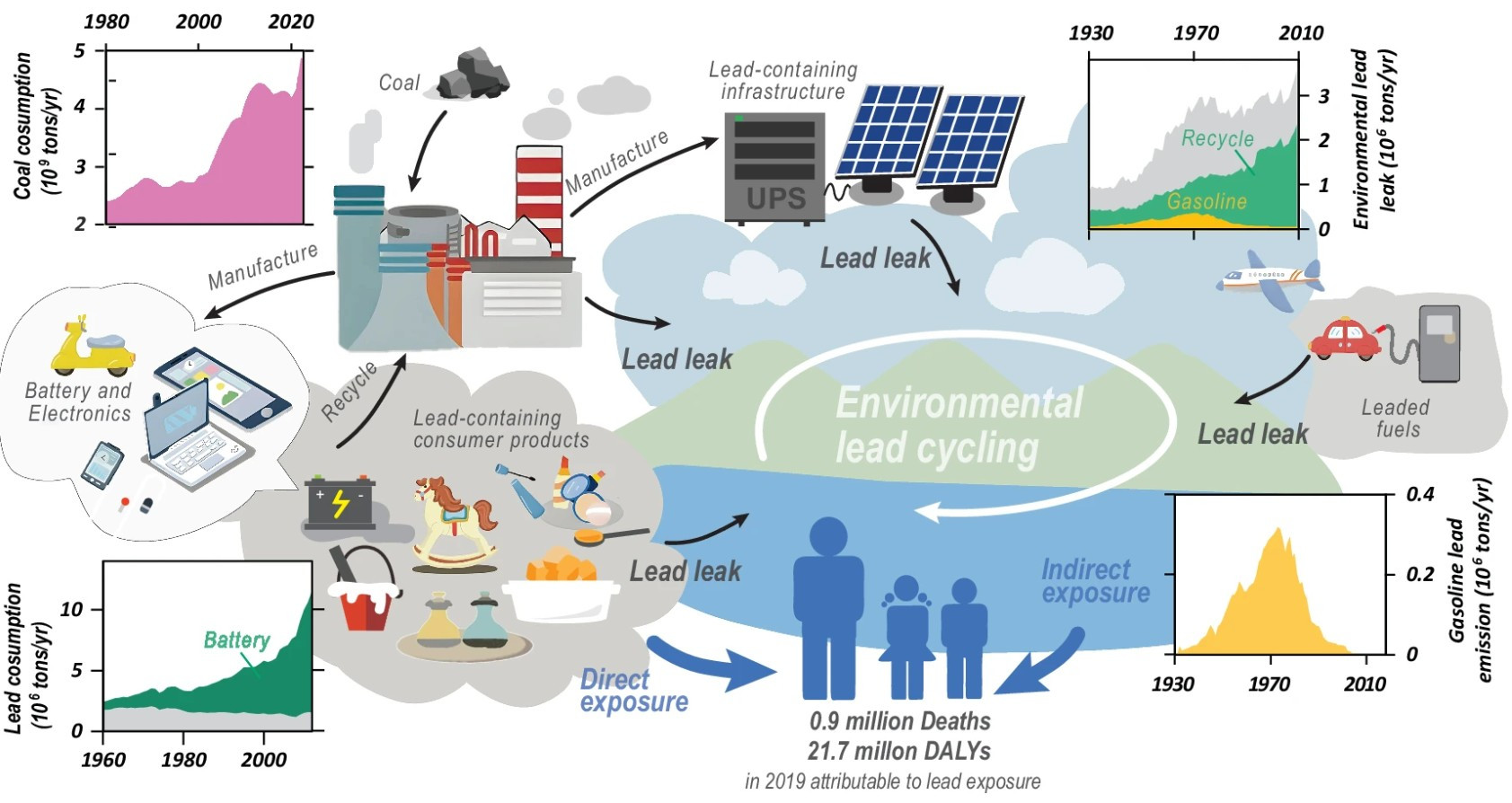
Diagram showing how lead cycles through the environment. Lead leaks into nature from coal combustion, lead acid battery recycling, re-circulation of old lead pollution, and products containing lead, resulting in ongoing human lead exposure. (Figure: Communications Earth & Environmental)
<関連情報>
- https://news.nus.edu.sg/global-lead-exposure-costs-trillions-endangers-children/
- https://www.nature.com/articles/s43247-025-02735-x
21世紀の環境鉛リスク Environmental lead risk in the 21st century
Mengli Chen,Ludovica Gazze,Francis J. DiTraglia,Reshmi Das,Jerome Nriagu,Yigal Erel,Edward A. Boyle,Caroline M. Taylor & Dominik Weiss
Communications Earth & Environment Published:30 September 2025
DOI:https://doi.org/10.1038/s43247-025-02735-x
Abstract
Lead has been central to technological development for centuries; however, its release into the environment and subsequent human exposure pose significant public health risks. The review presented here critically assesses the contemporary environmental lead risk as global lead production and use are rapidly increasing, largely driven by the rising demand for electrification. We show that environmental lead exposure persists today due to legacy contamination, ongoing coal usage, and insufficient protection of workforces during production, use, and recycling of lead-acid batteries and other lead-containing products, particularly in low- and middle- income countries. We estimate that contemporary childhood lead exposure alone leads to an annual global economic loss exceeding $3.4 trillion (2021 US dollars adjusted for purchasing power parity), with pronounced disparities between high- and low- and middle- income countries. To prevent a large-scale resurgence in lead exposure, we identify four critical areas for urgent policy intervention.