2025-10-02 マサチューセッツ工科大学(MIT)
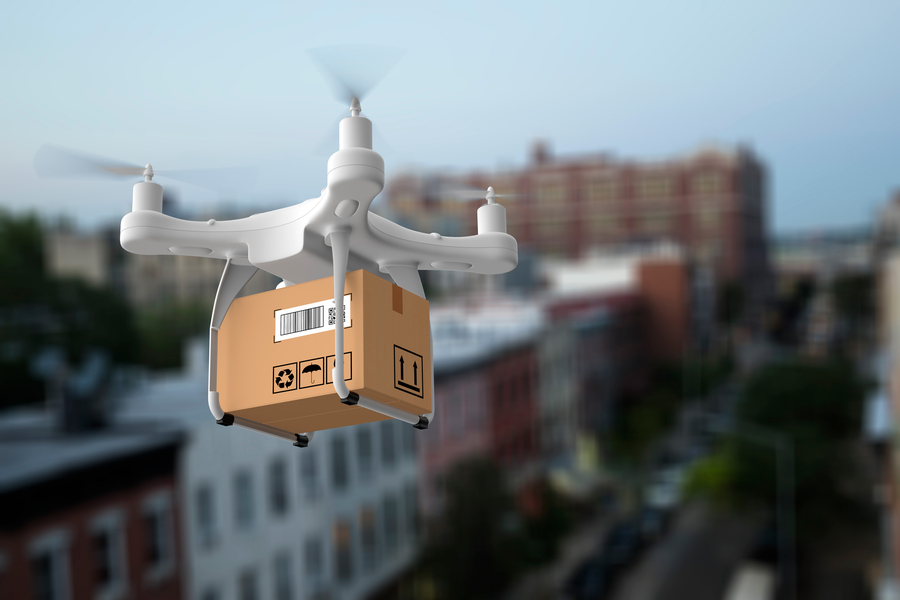 MIT researchers developed a framework that can help engineers design complex systems that involve many interconnected parts, such as delivery drones that navigate changing environments, in a way that explicitly accounts for the uncertainty in each component’s performance. Credit: iStock
<関連情報>
- https://news.mit.edu/2025/accounting-uncertainty-help-engineers-design-complex-systems-1002
- https://arxiv.org/html/2504.02766v2
- https://arxiv.org/pdf/2504.02766
システム協調設計における構成可能かつパラメータ的な不確実性について On Composable and Parametric Uncertainty in Systems Co-Design
Yujun Huang, Marius Furter, Gioele Zardini
arXiv last revised 11 Aug 2025 (this version, v2)
DOI:https://doi.org/10.48550/arXiv.2504.02766

Figure 4:Trade-off between payload and lifetime cost for a fixed task profile, free choice of battery and actuators, and deterministic battery and actuator parameters. Pairs of payload and lifetime cost in the green region are feasible while those in the orange region are not. A larger payload requires higher lifetime cost, illustrating the monotonicity of co-design. Specific choices of battery technologies and actuators are shown for some optimal solutions.
Abstract
Optimizing the design of complex systems requires navigating interdependent decisions, heterogeneous components, and multiple objectives. Our monotone theory of co-design offers a compositional framework for addressing this challenge, modeling systems as Design Problems (DPs), representing trade-offs between functionalities and resources within partially ordered sets. While current approaches model uncertainty using intervals, capturing worst- and best-case bounds, they fail to express probabilistic notions such as risk and confidence. These limitations hinder the applicability of co-design in domains where uncertainty plays a critical role. In this paper, we introduce a unified framework for composable uncertainty in co-design, capturing intervals, distributions, and parametrized models. This extension enables reasoning about risk-performance trade-offs and supports advanced queries such as experiment design, learning, and multi-stage decision making. We demonstrate the expressiveness and utility of the framework via a numerical case study on the uncertainty-aware co-design of task-driven Unmanned Aerial Vehicles (UAVs).