2025-10-02 ジョンズ・ホプキンス大学(JHU)
<関連情報>
- https://hub.jhu.edu/2025/10/02/rogue-planet-growth-spurt/
- https://iopscience.iop.org/article/10.3847/2041-8213/ae09a8
自由浮遊惑星質量天体における降着バーストの発見 Discovery of an Accretion Burst in a Free-floating Planetary-mass Object
Victor Almendros-Abad, Aleks Scholz, Belinda Damian, Ray Jayawardhana, Amelia Bayo, Laura Flagg, Koraljka Mužić, Antonella Natta, Paola Pinilla, and Leonardo Testi
The Astrophysical Journal Letters Published: 2025 October 2
DOI:10.3847/2041-8213/ae09a8
Abstract
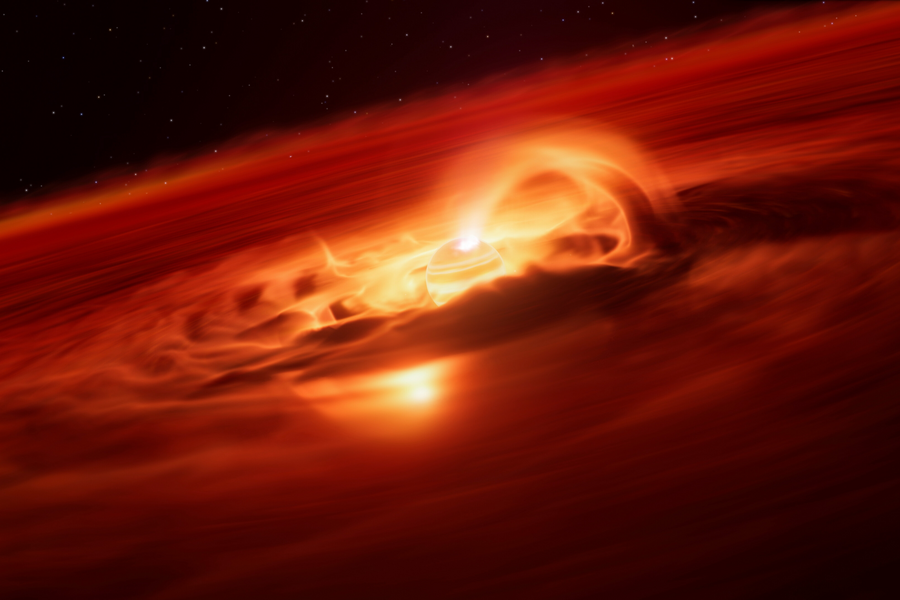
We report the discovery of a long-lasting burst of disk accretion in Cha J11070768-7626326 (Cha 1107-7626), a young, isolated, 5–10 MJupiter object. In spectra taken with XSHOOTER at ESO’s Very Large Telescope as well as NIRSpec and MIRI on the James Webb Space Telescope, the object transitions from quiescence in 2025 April–May to a strongly enhanced accretion phase in 2025 June–August. The line flux changes correspond to a 6–8-fold increase in the mass accretion rate, reaching 10−7 MJupiteryr−1, the highest measured in a planetary-mass object. During the burst, the Hα line develops a double-peaked profile with redshifted absorption, as observed in stars and brown dwarfs undergoing magnetospheric accretion. The optical continuum increases by a factor of 3–6; the object is ∼1.5–2 mag brighter in the R band during the burst. Mid-infrared continuum fluxes rise by 10%–20%, with clear changes in the hydrocarbon emission lines from the disk. We detect water vapour emission at 6.5–7 μm, which were absent in quiescence. By the end of our observing campaign, the burst was still ongoing, implying a duration of at least 2 months. A 2016 spectrum also shows high accretion levels, suggesting that this object may undergo recurring bursts. The observed event is inconsistent with typical variability in accreting young stars and instead matches the duration, amplitude, and line spectrum of an EXor-type burst, making Cha1107-7626 the first substellar object with evidence of a potentially recurring EXor burst.