2025-09-16 清華大学
<関連情報>
- https://www.tsinghua.edu.cn/en/info/1245/14493.htm
- https://www.nature.com/articles/s41586-025-09476-z
超伝導プロセッサ上のトポロジカルなプレサーマル強ゼロモード Topological prethermal strong zero modes on superconducting processors
Feitong Jin,Si Jiang,Xuhao Zhu,Zehang Bao,Fanhao Shen,Ke Wang,Zitian Zhu,Shibo Xu,Zixuan Song,Jiachen Chen,Ziqi Tan,Yaozu Wu,Chuanyu Zhang,Yu Gao,Ning Wang,Yiren Zou,Aosai Zhang,Tingting Li,Jiarun Zhong,Zhengyi Cui,Yihang Han,Yiyang He,Han Wang,Jia-Nan Yang,… Dong-Ling Deng
Nature Published:27 August 2025
DOI:https://doi.org/10.1038/s41586-025-09476-z
Abstract
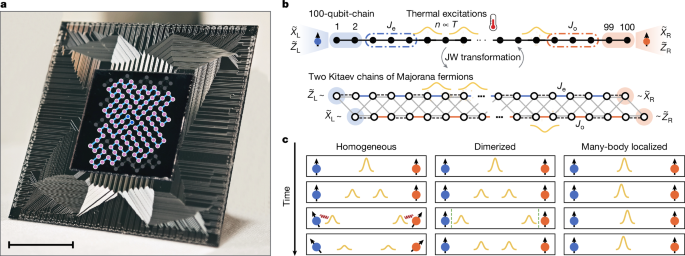
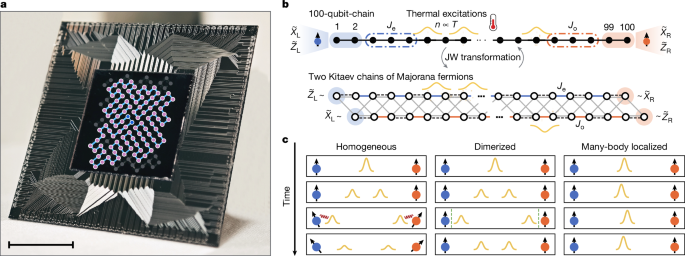
Symmetry-protected topological phases1,2,3,4 cannot be described by any local order parameter and are beyond the conventional symmetry-breaking model5. They are characterized by topological boundary modes that remain stable under symmetry respecting perturbations1,2,3,4,6,7,8. In clean, gapped systems without disorder, the stability of these edge modes is restricted to the zero-temperature manifold; at finite temperatures, interactions with mobile thermal excitations lead to their decay9,10,11. Here we report the observation of a distinct type of topological edge mode12,13,14, which is protected by emergent symmetries and persists across the entire spectrum, in an array of 100 programmable superconducting qubits. Through digital quantum simulation of a one-dimensional disorder-free stabilizer Hamiltonian, we observe robust long-lived topological edge modes over up to 30 cycles for a wide range of initial states. We show that the interaction between these edge modes and bulk excitations can be suppressed by dimerizing the stabilizer strength, leading to an emergent U(1) × U(1) symmetry in the prethermal regime of the system. Furthermore, we exploit these topological edge modes as logical qubits and prepare a logical Bell state, which exhibits persistent coherence, despite the system being disorder-free and at finite temperature. Our results establish a viable digital simulation approach15,16,17,18 to experimentally study topological matter at finite temperature and demonstrate a potential route to construct long-lived, robust boundary qubits in disorder-free systems.