
2025-07-14 中国科学院(CAS)
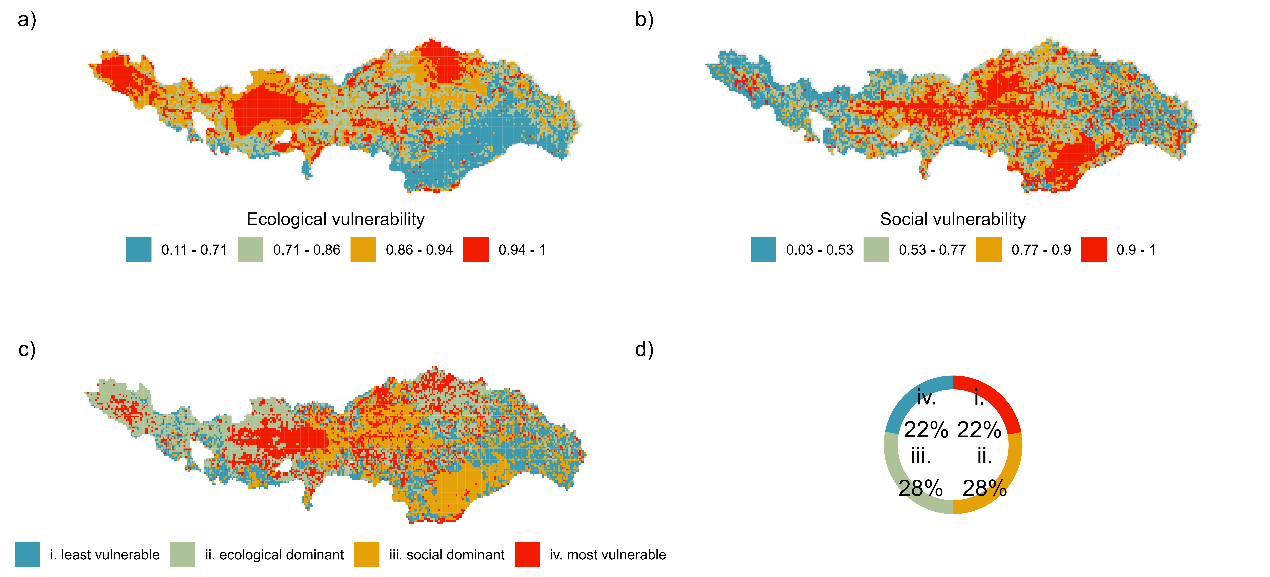
Social-ecological vulnerability assessment for the Yarlung Tsangpo River Basin. Ecological (a) and social (b) vulnerabilities are estimated for each pixel, warmer colors indicate higher vulnerabilities, and cooler colors lower. The four classes are defined based on the social and ecological vulnerabilities (c) and their respective areas as a percentage of the entire basin (d). (Image by WBG)
<関連情報>
- https://english.cas.cn/newsroom/research_news/life/202507/t20250714_1047337.shtml
- https://www.sciencedirect.com/science/article/abs/pii/S0301479725017980
ヤールン・ツアンポー川流域における社会的・生態学的ストレス要因に対する生物多様性の脆弱性 Vulnerability of biodiversity to social and ecological stressors in the Yarlung Tsangpo River Basin
Sifeng Wu, Man Liu, Dezhi Wang, Quanfa Zhang
Journal of Environmental Management Available online: 15 May 2025
DOI:https://doi.org/10.1016/j.jenvman.2025.125822
Highlights
- We assessed biodiversity vulnerability for a most biodiverse but fragile ecosystem.
- Vulnerability indicators in YTRB were highly independent and spatially decoupled.
- 28 % of the area showed conflicts between conservation and social development.
- Vegetation was the most vulnerable aspect in the more biodiverse and forested part.
Abstract
Biodiversity is vital to the sustainable future of human beings, yet environmental changes and anthropogenic activities cause an alarming rate of species extinction globally, threatening the conservation of biodiversity. Here, we assessed the vulnerabilities of one of the most biodiverse but also most fragile ecosystems in the world, the Yarlung Tsangpo River Basin (YTRB), to multiple ecological and social stressors. We conducted an indicator-based assessment to quantify the vulnerability of the YTRB to multiple social and ecological stressors; and evaluated the interactions among aspects of vulnerabilities by comparing their spatial patterns. Our results show that areas with the highest ecological vulnerabilities were highly clustered, and the most critical determinants for ecological vulnerability were temperature and precipitation variations. Also, increases in population density and high human footprint were the most vulnerable aspects of social vulnerability, accounting for 39 % and 31 % of the total area. Spatial patterns of social and ecological vulnerabilities were different. Areas with high ecological vulnerability were mostly observed in the west and north part of the basin; whereas high social vulnerabilities mostly along the central river and the southeast part. The selected ten variables representing social and ecological vulnerabilities were highly independent, especially the four variables relating to social vulnerability. Our results reveal significant conflicts between conservation and development because of the large areas showing high social and ecological vulnerabilities (22 % of the entire area). For the part of the YTRB belonging to the global biodiversity hotspots, also being the forested areas, the most vulnerable ecological aspect was vegetation loss, rather than climate variations. Our study provides a temporally dynamic and spatially explicit evaluation of social and ecological vulnerabilities of the YTRB, contributing to informed decision-making to sustain the biodiversity of this highly fragile ecosystem, meaningful to global biodiversity conservation.


