2026-03-17 中国科学院(CAS)
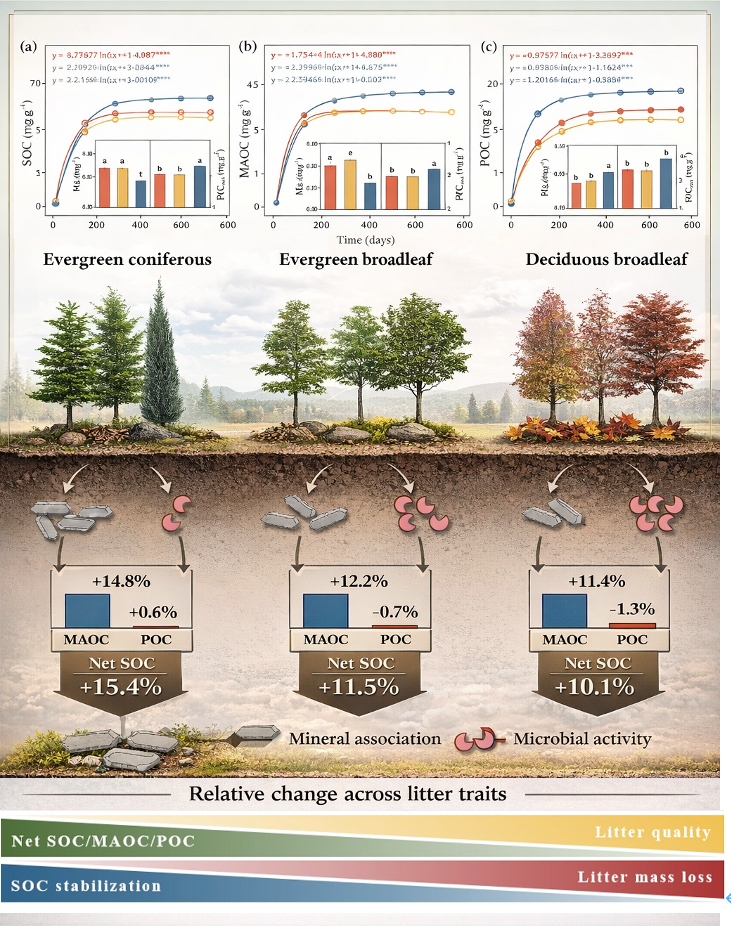
Conceptual diagram illustrating how litter decomposition from different plant growth forms drives the formation and stabilization of soil organic carbon. (Image by LIU Zhanfeng et al.)
<関連情報>
- https://english.cas.cn/newsroom/research-news/202603/t20260318_1152843.shtml
- https://academic.oup.com/jpe/advance-article/doi/10.1093/jpe/rtag040/8520923
実験室での培養実験により、針葉樹の落葉は広葉樹の落葉よりも分解速度が遅いにもかかわらず、土壌炭素の安定化効果が高いことが明らかになった Laboratory incubation reveals greater soil carbon stabilization by coniferous leaf litter than by broadleaf leaf litter despite slower decomposition
Panpan Wu ,Ting Wu ,Yun Zhang ,Yidong Ding ,Zhanfeng Liu ,Rong Mao
Journal of Plant Ecology Published:14 March 2026
DOI:https://doi.org/10.1093/jpe/rtag040
Abstract
Plant growth forms influence soil organic carbon (SOC) turnover through litter quality, yet their impacts on SOC formation pathways (particulate [POC] vs. mineral-associated [MAOC]) remain poorly understood in forest ecosystems. Here, leaf litter of deciduous broadleaf (4 species), evergreen broadleaf (5 species), and evergreen coniferous trees (3 species) was collected in a subtropical forest. Using natural δ13C abundance, we traced litter-derived carbon flows into POC and MAOC pools during a 360-day laboratory incubation. Despite 18–32% lower mass loss, coniferous litter contributed 1.4- to 2.1-fold more to net SOC accumulation than broadleaf litter. This resulted from the higher SOC, MAOC, and POC formation efficiencies (coniferous: 28–32%; broadleaf: 11–19%). Litter C:N ratio was the primary driver of net SOC and POC balance. In contrast, net MAOC balance was co-regulated by litter-derived dissolved organic C production and biodegradation. Our results suggest that evergreen coniferous litter, despite its lower substrate quality and slower decomposition rate, may promote greater SOC accrual and stabilization than both deciduous and evergreen broadleaf litter. This counterintuitive finding underscores that recalcitrant coniferous litter enhances long-term soil C sequestration efficiency, and imply that afforestation with coniferous species may benefit SOC sequestration by promoting MAOC formation in subtropical forests.