2026-01-28 カリフォルニア大学サンディエゴ校(UCSD)
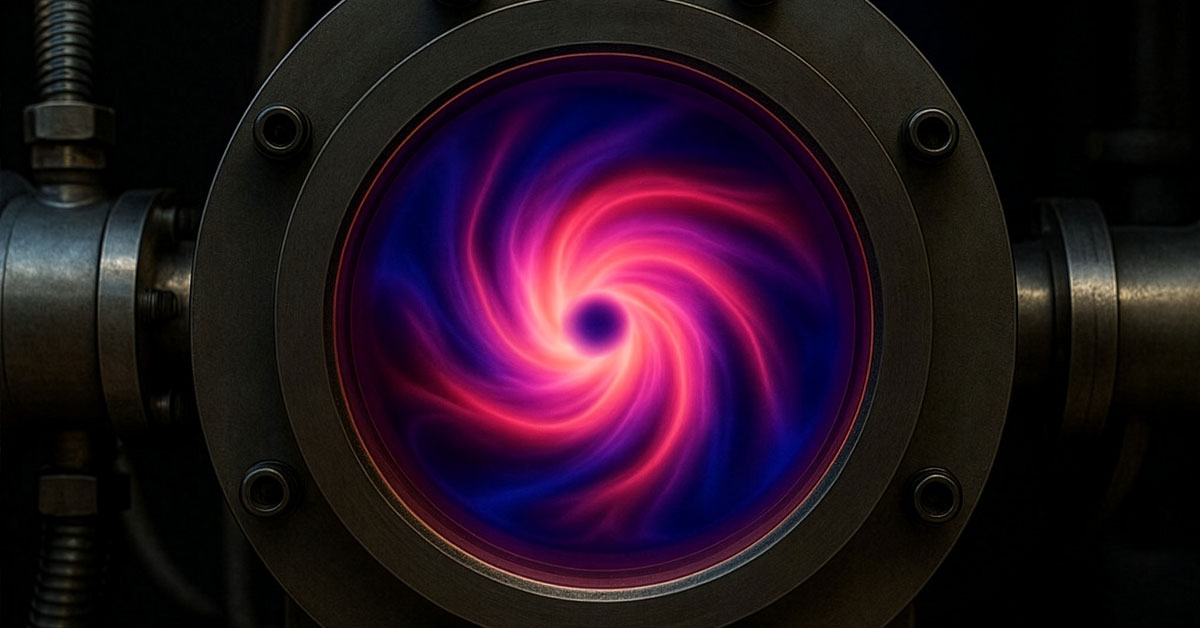
Swirl combustor ignites hydrogen molecules. Credit: SDSC, AI-generated image
<関連情報>
- https://today.ucsd.edu/story/hydrogen-power-gets-a-spark-thanks-to-sdscs-expanse
- https://www.sciencedirect.com/science/article/pii/S0010218025004985
渦流燃料噴射器における水素-空気リフト炎の数値解析 A numerical investigation of H2-air lifted flames in swirling fuel injectors
Brandon W. Li, Benjamin W. Keeton, Keiko K. Nomura, Antonio L. Sánchez, Forman A. Williams
Combustion and Flame Available online 17 September 2025
DOI:https://doi.org/10.1016/j.combustflame.2025.114461
Abstract
Numerical simulations are conducted to study fundamental aspects of combustion stabilization in hydrogen-fueled gas turbines. The study focuses on laminar lifted flames at moderate Reynolds numbers in axisymmetric configurations, where a swirling hydrogen jet diluted with nitrogen is injected into stagnant, preheated, pre-compressed air. The conservation equations are formulated in the low-Mach-number approximation, employing a mixture-averaged model for molecular transport. Fuel oxidation is modeled using both detailed chemical kinetics and a previously derived explicit one-step reduced mechanism, which assumes steady-state behavior for chemical intermediates—a valid approximation under the high-pressure conditions typical of gas-turbine combustion chambers, and the accuracy of that approximation is ascertained. The investigation explores the interplay between vortex breakdown and flame dynamics, including liftoff and blowoff, as functions of the swirl and Damköhler numbers. The results elucidate the required flow criteria for lifted-flame stabilization and demonstrate the predictive capability and computational cost reduction of the one-step chemistry in connection with hydrogen combustion at high pressures. A regime diagram in a plane of swirl number and Damköhler number is derived, and conditions for the occurrence of steadily pulsating flames are established, along with indications of amplitudes and frequencies of those oscillations. While clearly not directly applicable to practical turbulent-flow conditions, the results can be useful in future analyses and design concepts for combustion chambers of hydrogen-fueled gas turbines.
Novelty and significance statement
This work presents, for the first time, results of computations of nitrogen-diluted hydrogen flame behavior for swirling fuel jets issuing into air that has been heated to temperatures expected at the entrance to gas-turbine combustion chambers. It is novel in that it compares predictions made using both detailed combustion chemistry and one-step systematically derived reduced chemistry. A significant finding is that the results obtained with the reduced chemistry are in general agreement with those of the detailed chemistry, thereby affording substantial reductions in computational cost. Another novel and significant result is the determination of injection and swirl gas-turbine conditions required for stable lifted flames to occur, rather than attached flames or blowoff. The existence and characteristics of pulsating oscillations also are established for the first time. These results will be useful in the design and analysis of hydrogen-fueled gas-turbine combustion chambers.