2026-02-06 東北大学
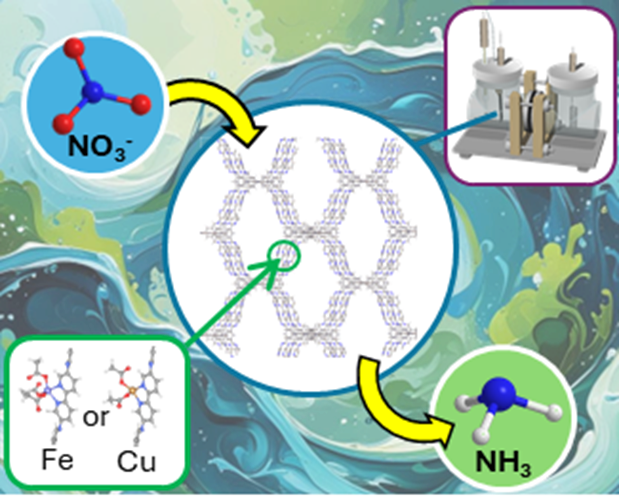
図1. 3次元共有結合性有機構造体(COF)TU-82を用いた、電気化学的硝酸イオン還元反応(eNO3–RR)によるアンモニア(NH3)合成の概念図。農業排水や工業排水中の主要な汚染物質である硝酸イオン(NO₃⁻)が、3次元COF TU-82の骨格内に組み込まれた金属-ビピリジン触媒活性点を介して、常温・常圧条件下で付加価値の高いNH3へと変換される様子を示している。
<関連情報>
- https://www.tohoku.ac.jp/japanese/2026/02/press20260206-02-3D.html
- https://www.tohoku.ac.jp/japanese/newimg/pressimg/tohokuuniv-press20260206_02web_.pdf
- https://pubs.rsc.org/en/content/articlelanding/2026/ta/d5ta07989f
[8 + 2]結合した三次元金属-ビピリジン共有結合有機骨格上での電気触媒硝酸塩還元 による 効率的なアンモニア合成 Efficient ammonia synthesis via electrocatalytic nitrate reduction over a [8 + 2]-connected three-dimensional metal-bipyridine covalent organic framework
Tsukasa Irie,Ayumu Kondo,Kai Sun,Kohki Sasaki,Mika Nozaki,Shiho Tomihari,Kotaro Sato,Tokuhisa Kawawaki,Yu Zhao,Saikat Das and Yuichi Negishi
Journal of Materials Chemistry A Published:02 Feb 2026
DOI:https://doi.org/10.1039/D5TA07989F
Abstract
Covalent organic frameworks (COFs) have recently emerged as promising platforms for electrocatalytic nitrate reduction to ammonia (NO3RR), yet most reported systems are limited to two-dimensional architectures. Herein, we present TU-82, a structurally distinct 3D COF featuring an intricate [8 + 2]-connected bcu topology derived from the reticulation of an octatopic D2h-symmetric tetragonal prism node and a C2-symmetric bipyridyl linker. TU-82 exhibits high crystallinity, permanent porosity, and robust structural integrity, enabling precise postsynthetic metalation at bipyridyl coordination sites to yield catalytically active TU-82-Fe and TU-82-Cu frameworks. Among them, TU-82-Fe demonstrates superior NO3RR performance, delivering a faradaic efficiency (FE) of 88.1% at −0.6 V (RHE) and an ammonia yield rate of 2.87 mg h−1 cm−2 at −0.8 V (RHE), together with a turnover frequency of 7.2 h−1 and excellent operational stability. Density functional theory calculations reveal that the enhanced activity of TU-82-Fe originates from a lower energy barrier (0.354 eV) for the rate-determining NO* → NHO* step along the NHO-mediated reaction pathway. This work pioneers a structural blueprint for deploying 3D COFs in electrocatalysis, fostering deeper insights into framework-controlled reactivity and offering new routes to sustainable nitrate management.