

2026-02-04 東北大学
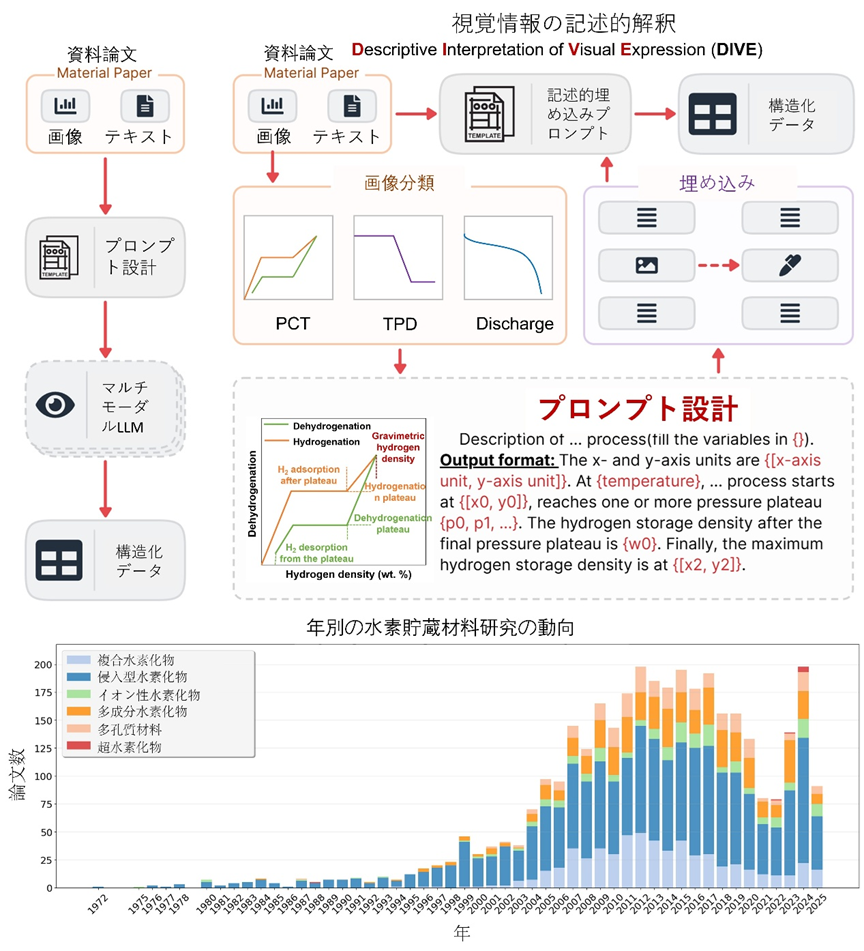
図1. DIVEのマルチエージェントワークフロー(右上)と従来手法(左上)の比較、および水素貯蔵材料データベースにおける収集文献の分布(下)
<関連情報>
- https://www.tohoku.ac.jp/japanese/2026/02/press20260204-01-DIVE.html
- https://www.tohoku.ac.jp/japanese/newimg/pressimg/tohokuuniv-press20260204_01web_DIVE.pdf
- https://pubs.rsc.org/en/content/articlelanding/2026/sc/d5sc09921h
AIエージェントによる水素貯蔵材料の発見への「DIVE」 “DIVE” into hydrogen storage materials discovery with AI agents
Di Zhang, Xue Jia, Hung Ba Tran, Seong Hoon Jang,Linda Zhang,Ryuhei Sato,Yusuke Hashimoto,Toyoto Sato,Kiyoe Konno,Shin-ichi Orimo and Hao Li
Chemical Science Published:03 Feb 2026
DOI:https://doi.org/10.1039/D5SC09921H
Abstract
Despite the surge of AI in energy materials research, fully autonomous workflows that connect high-precision experimental knowledge to the discovery of credible new energy-related materials remain at an early stage. Here, we develop the Descriptive Interpretation of Visual Expression (DIVE) multi-agent workflow, which systematically reads and organizes experimental data from graphical elements in scientific literature. Applied to solid-state hydrogen storage materials—a class of materials central to future clean-energy technologies—DIVE markedly improves the accuracy and coverage of data extraction compared to the direct extraction method, with gains of 10–15% over commercial models and over 30% relative to open-source models. Building on a curated database of over 30 000 entries from >4000 publications, we establish a rapid inverse-design AI workflow capable of proposing new materials within minutes. This transferable, end-to-end paradigm illustrates how multimodal AI agents can convert literature-embedded scientific knowledge into actionable innovation, offering a scalable pathway for accelerated discovery across chemistry and materials science.

