2026-01-09 中国科学院(CAS)
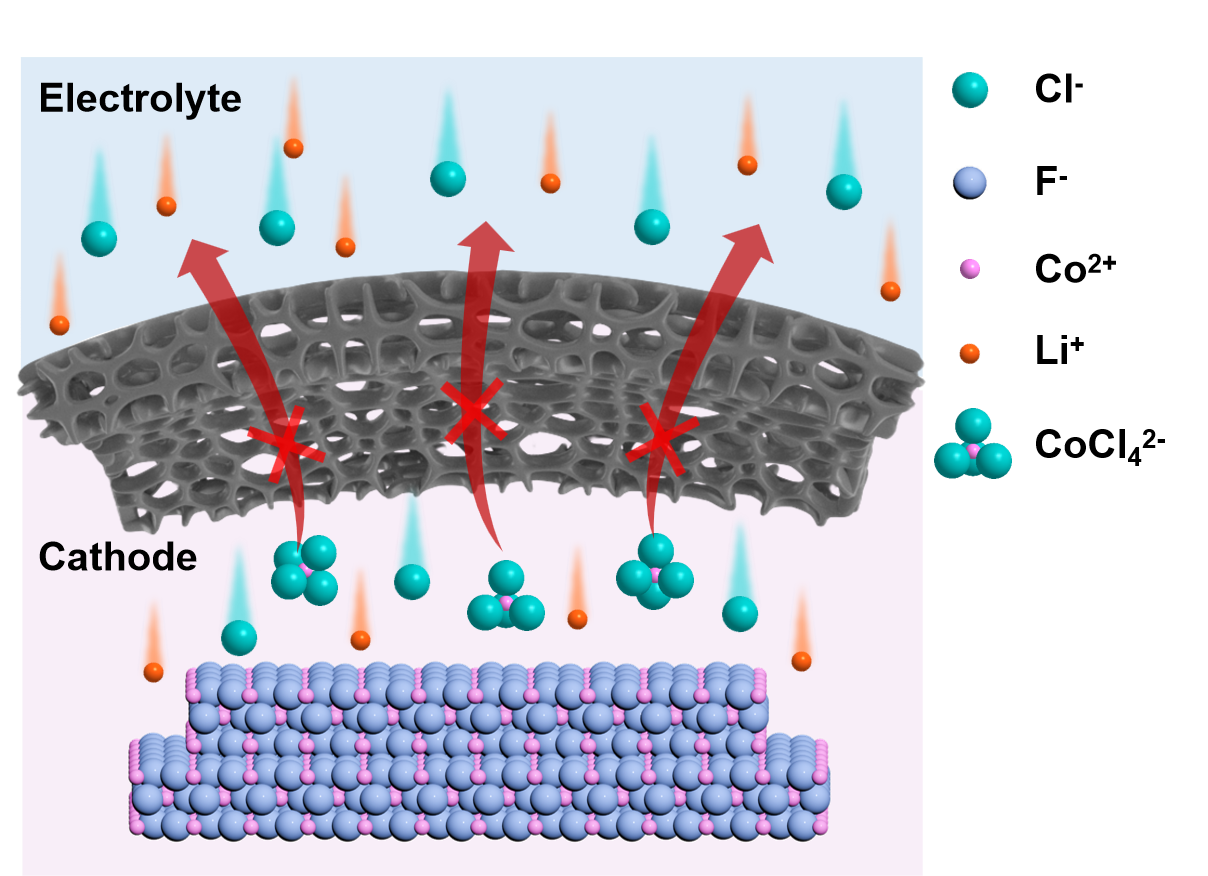
Illustration of size selective transmission of ions between electrolyte and cathode enabled by sub-nanoporous interface (Image by XU Mengfan)
<関連情報>
- https://english.cas.cn/newsroom/research-news/202602/t20260210_1150313.shtml
- https://advanced.onlinelibrary.wiley.com/doi/10.1002/advs.202521241
高性能CoF 2熱電池正極のためのCOF由来のサブナノポーラス界面による選択的閉じ込め Selective Confinement by a COF-Derived Sub-Nanoporous Interface for High-Performance CoF2 Thermal Battery Cathodes
Mengfan Xu, Jun Zhang, Lili Zhao, Ying Chu, Furui Luo, Xinping Cao, Shengnan Guo, Xueying Wang, Yongping Zhu, Song Wang
Advanced Science Published: 04 January 2026
DOI:https://doi.org/10.1002/advs.202521241
ABSTRACT
The pervasive dissolution of transition metal fluoride (TMF) cathodes presents a fundamental barrier to their application in high-voltage thermal batteries and other Li+-conducting systems. Herein, we report a novel selective confinement strategy inspired by ion sieving to overcome this challenge by constructing a sub-nanoporous carbon interface in situ on CoF2 particles. Derived from a covalent organic framework (COF), this interface features precisely defined 0.54 nm pores that exploit the size difference between Li+ ions (∼0.15 nm) and dissolved transition metal fluoride derived complex ions (∼0.8 nm), effectively confining the active material while enabling unimpeded ionic conduction. This tailored design successfully suppresses cathode shuttling effect, enabling a thermal battery that delivers an exceptional discharge plateau >2.5 V, a high specific capacity of 365 mAh g−1, and a remarkable specific energy of 882 Wh kg−1 at 100 mA cm−2. Mechanism studies confirm the dissolved transition metal fluoride derived complex ions as CoCl42− and efficient confinement of it. This work provides a general and effective interface engineering strategy for unlocking the full potential of metal fluoride cathodes in advanced energy storage.