2026-01-08 国立天文台
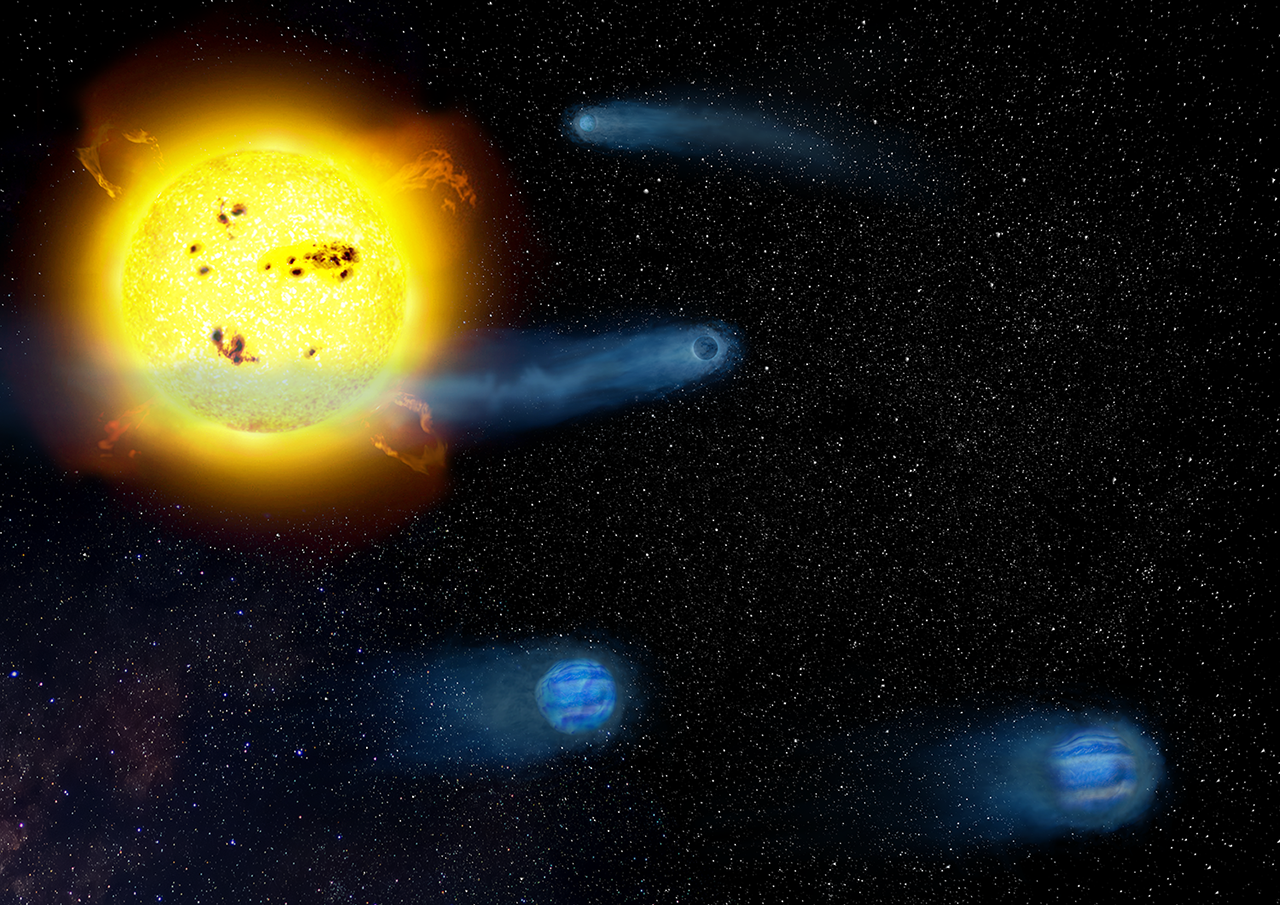
若い恒星を公転する4つの惑星の想像図。ふわふわの大気が宇宙空間に流出しているかもしれない。(クレジット:アストロバイオロジーセンター)
<関連情報>
- https://www.nao.ac.jp/news/science/2026/20260108-abc.html
- https://www.abc-nins.jp/newborn_planets_are_puffy/
- https://www.nature.com/articles/s41586-025-09840-z
銀河系で最も一般的な惑星系の若い祖先 A young progenitor for the most common planetary systems in the Galaxy
John H. Livingston,Erik A. Petigura,Trevor J. David,Kento Masuda,James Owen,David Nesvorný,Konstantin Batygin,Jerome de Leon,Mayuko Mori,Kai Ikuta,Akihiko Fukui,Noriharu Watanabe,Jaume Orell Miquel,Felipe Murgas,Hannu Parviainen,Judith Korth,Florence Libotte,Néstor Abreu García,Pedro Pablo Meni Gallardo,Norio Narita,Enric Pallé,Motohide Tamura,Atsunori Yonehara,Andrew Ridden-Harper,… Lorenzo Pino
Nature Published:07 January 2026
DOI:https://doi.org/10.1038/s41586-025-09840-z
Abstract
The Galaxy’s most common known planetary systems have several Earth-to-Neptune-size planets in compact orbits1. At small orbital separations, larger planets are less common than their smaller counterparts by an order of magnitude. The young star V1298 Tau hosts one such compact planetary system, albeit with four planets that are uncommonly large (5 to 10 Earth radii)2,3. The planets form a chain of near-resonances that result in transit-timing variations of several hours. Here we present a multi-year campaign to characterize this system with transit-timing variations, a method insensitive to the intense magnetic activity of the star. Through targeted observations, we first resolved the previously unknown orbital period of the outermost planet. The full 9-year baseline from these and archival data then enabled robust determination of the masses and orbital parameters for all four planets. We find the planets have low, sub-Neptune masses and nearly circular orbits, implying a dynamically tranquil history. Their low masses and large radii indicate that the inner planets underwent a period of rapid cooling immediately after dispersal of the protoplanetary disk. Still, they are much less dense than mature planets of comparable size. We predict the planets will contract to 1.5–4.0 Earth radii and join the population of super-Earths and sub-Neptunes that nature produces in abundance.