2025-12-26 京都大学
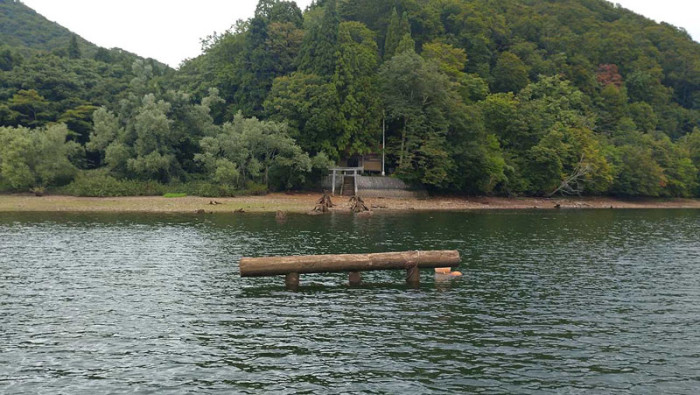
桧原湖に水没している二の鳥居。奥に桧原山神社と一の鳥居が見える。
<関連情報>
- https://www.kyoto-u.ac.jp/ja/research-news/2025-12-26-0
- https://www.kyoto-u.ac.jp/sites/default/files/2025-12/web_1225_Yamasaki-1e214d54371d8171256212d2a3e97922.pdf
- https://www.sciencedirect.com/science/article/pii/S1296207425002419
水没した宿場町の復元:桧原湖畔の桧原集落の微地形解析 Reconstructing a submerged post town: Microtopographic analysis of Hibara Village beneath Lake Hibara
Wataru Tanikawa, Shintaro Yamasaki, Tetsuya Yamamoto, Jun Kimura, Masao Yoshida, Hisashi Nakagawa, Akihiro Shimada, Yuhji Yamamoto, Randy Sasaki, Takehiro Hirose
Journal of Cultural Heritage Available online: 22 December 2025
DOI:https://doi.org/10.1016/j.culher.2025.11.003
Highlights
- Reconstructed submerged townscape using multibeam sonar data.
- Identified roads and parcel boundaries from CS 3D and historical maps.
- Revealed land-use zoning linked to alluvial-fan topography.
- Showed town planning utilized alluvial-fan hydrological features.
- Found lake sediments obscured rivers, bridges, and irrigation traces.
Abstract
Hibara Village, a former post town in Fukushima Prefecture, Northern Japan, was submerged beneath Lake Hibara following the 1888 eruption of Mount Bandai. Since its submergence, the area has remained largely undisturbed by land development, suggesting that many of its original features have been well preserved. To reconstruct the village’s townscape, we conducted a high-resolution microtopographic survey using multibeam echo sounder (MBES) data and generated CS 3D maps for spatial analysis. By comparing these results with historical cadastral maps, we identified the locations of land parcels, roads, irrigation canals, and tree-lined pathways. Topographic analysis revealed that residential areas were situated at the fan toe of an alluvial cone, agricultural fields in the mid-fan area, and irrigation canals along the fan’s base. This spatial organization suggests that the settlement was strategically designed to exploit the area’s hydrological characteristics. However, the accumulation of lake sediments since the eruption has obscured microtopographic features on the southern side of the site, preventing confirmation of the townscape in that area and the precise course of the former river. This study demonstrates the effectiveness of integrating acoustic survey methods with historical records to reconstruct submerged archaeological landscapes.