2025-12-22 シカゴ大学

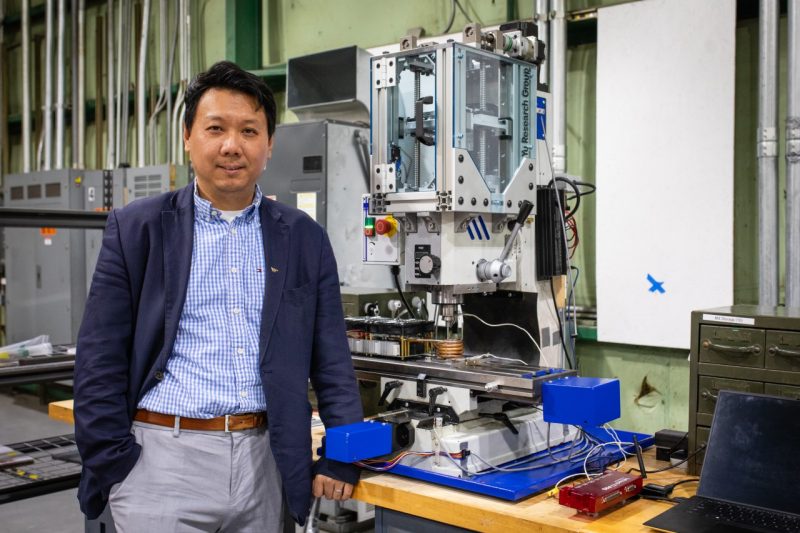
Image courtesy of the Collection of Pablo Clemente-Colon, chief scientist National Ice Center
<関連情報>
- https://news.uchicago.edu/story/using-quantum-mechanics-researchers-crack-hidden-chemistry-ice
- https://www.pnas.org/doi/10.1073/pnas.2516805122
欠陥の作用:氷の光物理学と光化学の形成 Defects at play: Shaping the photophysics and photochemistry of ice
Marta Monti, Yu Jin, Gonzalo Díaz Mirón, +3 , and Ali Hassanali
Proceedings of the National Academy of Sciences Published:November 20, 2025
DOI:https://doi.org/10.1073/pnas.2516805122
Significance
The interaction of ultraviolet (UV) light with ice drives fundamental atmospheric and planetary processes. Yet, the molecular transformations occurring in ice upon UV absorption and emission remain poorly understood. In this study, we employ advanced electronic structure calculations of ground and excited states to reveal that lattice defects play a central role in controlling the formation and relaxation of photoproducts in ice. We show how vacancies, ionic species, and topological defects influence the characteristic optical features of ice. Our findings offer insights into the microscopic modifications that light induces in ice, paving the way for experiments to probe these phenomena.
Abstract
The mechanisms by which light interacts with ice and the impact of photoinduced reactions are central to our understanding of environmental, atmospheric, and astrophysical processes. However, a microscopic description of the photoproducts originating from ultraviolet (UV) absorption and emission processes has remained elusive. Here, we explore the photochemistry of ice using time-dependent hybrid density functional theory on various models of pristine and defective ice Ih. Our investigation of the excited state potential energy surface of the crystal shows that UV absorption can lead to the formation of hydronium ions, hydroxyl radicals, and excess electrons. One of the dominant mechanisms of decay from the excited to the ground-state involves the recombination of the electron with the hydroxyl radical yielding hydronium-hydroxide ion-pairs. We find that the details of this charge recombination process sensitively depend on the presence of defects in the lattice, such as vacancies and preexisting photoproducts. We also observe the formation of Bjerrum defects following UV absorption; we suggest that, together with hydroxide anions, they are likely responsible for prominent features experimentally detected in long UV exposure absorption spectra, remarkably red-shifted relative to short exposure spectra. Our results highlight the key role of defects in determining the onset of absorption and emission processes in ice.