2025-12-16 中国科学院(CAS)
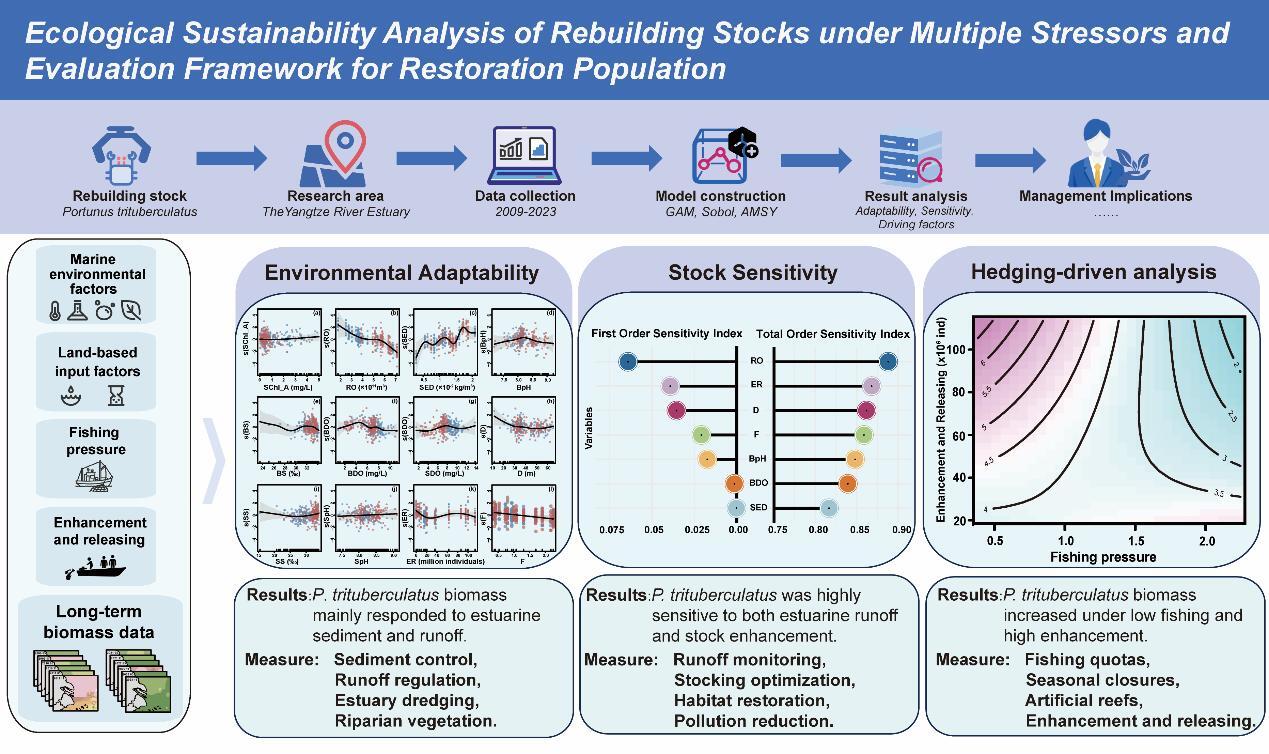
Research route and analytical framework. (Image by IOCAS)
<関連情報>
- https://english.cas.cn/newsroom/research_news/earth/202512/t20251216_1137275.shtml
- https://www.sciencedirect.com/science/article/abs/pii/S0301479725040940
多様なストレス要因下における資源回復の生態学的持続可能性と資源回復のための評価枠組み Ecological sustainability of rebuilding stocks under multiple stressors and evaluation framework for restoration of population
Xu Sun, Zhaopeng Zhang, Cui Liang, Yuanchao Wang, Wenzhuo Cao, Lei Zheng, Hui Zhang, Weiwei Xian
Journal of Environmental Management Available online: 28 November 2025
DOI:https://doi.org/10.1016/j.jenvman.2025.128118
Highlights
- Habitat change and human interventions affect population dynamics.
- Estuarine sediment and runoff are identified as key environmental factors.
- Global sensitivity analysis shows high sensitivity to runoff and stock enhancement.
- Optimal stock enhancement and moderate fishing pressure enhance resource recovery.
- Provided an evaluation framework for rebuilding stock in complex habitats.
Abstract
Marine ecosystems face increasing threats from environmental change and human activities, challenging populations’ stability and their rebuilding effectiveness. Proactive management requires a detailed understanding of how ecological and human factors interact to influence fishery productivity, as well as a quantitative assessment of the synergistic effects of environmental changes and management policies based on this understanding. This study investigated the population fluctuations of Portunus trituberculatus in the offshore waters of the Yangtze River Estuary from 2009 to 2023, developing an integrated framework to evaluate ecological restoration effectiveness under complex habitat conditions. Using multifactorial analytical methods, we explored relationships between biomass dynamics and 14 key factors, including environmental variables, land-based inputs, and human activities, to identify critical mechanisms driving population fluctuations and assess the species’ adaptability, sensitivity, and response patterns. Our analysis identified the optimal environmental range for P. trituberculatus, revealing that estuarine sediment concentration and runoff constitute key determinants of its distribution. The species exhibited heightened sensitivity to both estuarine runoff and stock enhancement, while fishing pressure and stock enhancement exhibited significant yet counteracting interactions. This study revealed the combined effects of human activities and natural factors on important rebuilding stock and, building on these findings, proposed a comprehensive evaluation framework for restoration strategies that mitigate the impacts of human disruption and environmental changes, offering practical guidance for the sustainable recovery of marine populations.