2025-12-02 NASA
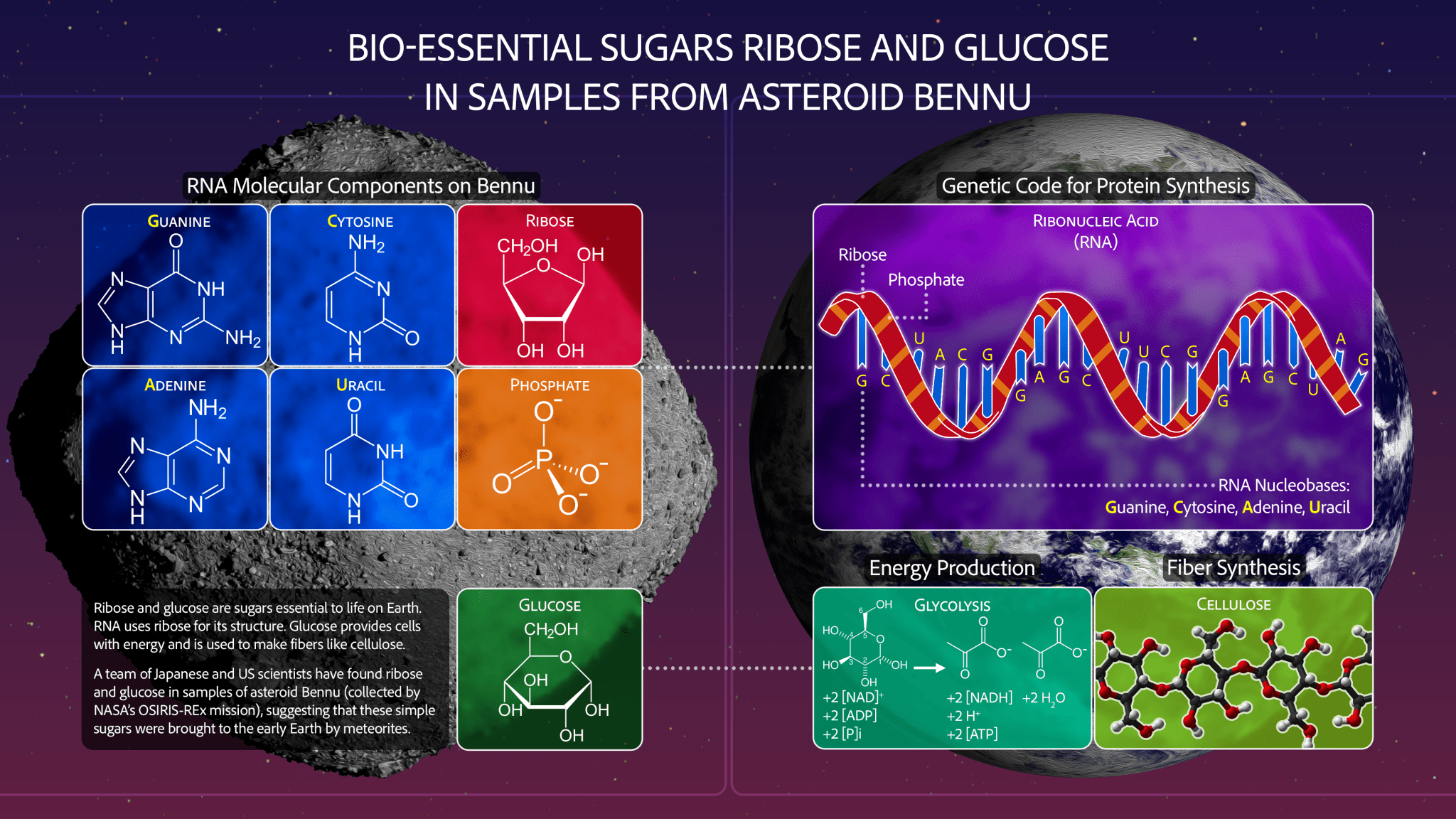
A team of Japanese and US scientists have discovered the bio-essential sugars ribose and glucose in samples of asteroid Bennu that were collected by NASA’s OSIRIS-REx mission. This finding builds on the earlier discovery of nucleobases (the genetic components of DNA and RNA), phosphate, and amino acids (the building blocks of proteins) in the Bennu samples, showing that the molecular ingredients of life could have been delivered to early Earth by meteorites. Download this graphic from NASA’s Scientific Visualization Studio website: https://svs.gsfc.nasa.gov/14932
NASA/Goddard/University of Arizona/Dan Gallagher
<関連情報>
- https://www.nasa.gov/missions/osiris-rex/sugars-gum-stardust-found-in-nasas-asteroid-bennu-samples/
- https://www.nature.com/articles/s41561-025-01838-6
- https://www.nature.com/articles/s41550-025-02694-5
小惑星ベンヌのサンプルに含まれる生体必須糖 Bio-essential sugars in samples from asteroid Bennu
Yoshihiro Furukawa,Sako Sunami,Yoshinori Takano,Toshiki Koga,Yuta Hirakawa,Yasuhiro Oba,Hiroshi Naraoka,Daisuke Saigusa,Takaaki Yoshikawa,Satoru Tanaka,Daniel P. Glavin,Jason P. Dworkin,Harold C. Connolly Jr. & Dante S. Lauretta
Nature Geoscience Published:02 December 2025
DOI:https://doi.org/10.1038/s41561-025-01838-6
Abstract
Deliveries of organic molecules from space, such as those found in carbonaceous meteorites, have long been hypothesized as a source of the inventory of the first life on Earth. This hypothesis is strengthened by detections of two of life’s fundamental building blocks—nucleobases and protein-building amino acids—in pristine samples returned by spacecraft from the carbonaceous asteroids Bennu and Ryugu. However, life also requires sugars, which cannot be searched for in Ryugu samples due to limited available mass, and their presence in some meteorites is equivocal owing to terrestrial exposure. Here we analyse an extract from a sample of asteroid (101955) Bennu collected by the OSIRIS-REx spacecraft and identify several bio-essential sugars, including ribose (RNA sugar) and glucose (metabolism substrate). These sugars complete the inventory of ingredients crucial to life. Their distribution is consistent with that in the condensation products of formaldehyde solution. Given that Bennu contains formaldehyde and originates from an ancient parent asteroid that underwent long-term alteration by aqueous fluids, we postulate that the detected sugars formed in the parent asteroid from brines containing formaldehyde. This indicates that material with all three components necessary to life could have been dispersed to prebiotic Earth and other inner planets.
ベンヌの母天体における水以前の極低温化学反応における重合を示唆する窒素と酸素に富む有機物質 Nitrogen- and oxygen-rich organic material indicative of polymerization in pre-aqueous cryochemistry on Bennu’s parent body
Scott A. Sandford,Zack Gainsforth,Michel Nuevo,Matthew A. Marcus,Hans A. Bechtel,Ryan C. Ogliore,Clive Jones,Gerardo Dominguez,Daniel P. Glavin,Jason P. Dworkin,Timothy J. McCoy,Sara S. Russell,Thomas J. Zega,Harold C. Connolly Jr & Dante S. Lauretta
Nature Astronomy Published:02 December 2025
DOI:https://doi.org/10.1038/s41550-025-02694-5
Abstract
Nitrogen-containing organic compounds play key biological roles, and their identification in primitive astromaterials such as meteorites can shed light on the origin of life. However, meteorites are typically contaminated by uncontrolled exposure to Earth. Here we show that pristine samples returned from asteroid Bennu contain polymeric organics exceptionally rich in nitrogen and oxygen. These polymers contain a variety of functional groups including amines, amides, N-heterocycles, and aliphatic and aromatic hydrocarbons, among others. They are seen in a carbonaceous vein with mineral inclusions and in multilayered organic sheets. Their morphology and composition indicate formation from pre-aqueous N-rich precursors and later modification during aqueous alteration. These findings demonstrate that asteroids like Bennu contain complex nitrogen-rich organic phases formed by pre-aqueous and aqueous processes, and they expand the known inventory of potential prebiotic extraterrestrial compounds.