2025-11-17 韓国基礎科学研究院(IBS)
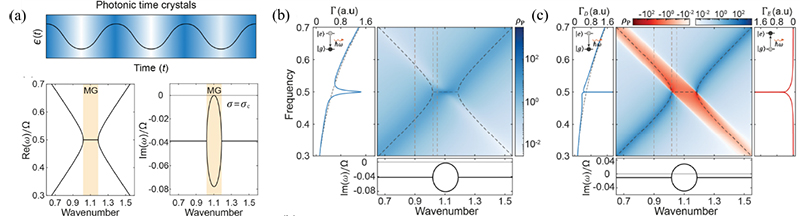
Figure 1. (a) Time-periodic modulation of the permittivity ε(t) forms a momentum-gap region. (b) In the high-loss regime, positive kDOS enhances spontaneous emission. (c) In the low-loss regime, negative kDOS indicates spontaneous emission excitation, where atoms absorb energy from time modulation while emitting photons. This process arises from non-Hermitian dynamics and non-orthogonal Floquet modes near exceptional-point boundaries.
<関連情報>
- https://www.ibs.re.kr/cop/bbs/BBSMSTR_000000000738/selectBoardArticle.do?nttId=26295&pageIndex=1&searchCnd=&searchWrd=#toggle
- https://journals.aps.org/prl/abstract/10.1103/5v2w-yg7v
フォトニック時間結晶における自然放出光の減衰と励起 Spontaneous Emission Decay and Excitation in Photonic Time Crystals
Jagang Park, Kyungmin Lee, Ruo-Yang Zhang, Hee-Chul Park, Jung-Wan Ryu, Gil Young Cho, Min Yeul Lee, Zhaoqing Zhang, Namkyoo Park et al.
Physical Review Letters Published: 22 September, 2025
DOI: https://doi.org/10.1103/5v2w-yg7v
Abstract
Over the last few decades, the predominant strategies for controlling spontaneous emission have involved tailoring the spatial surroundings of quantum emitters or atoms to create resonant or spatially periodic photonic structures. However, the rise of time-varying photonics has prompted a reevaluation of spontaneous emission in dynamically changing environments, especially within photonic time crystals, where optical properties undergo time-periodic modulation. Here, we apply classical light-matter interaction theory together with Floquet analysis to reveal a substantial enhancement of the spontaneous emission decay rate at the momentum gap frequency in photonic time crystals. Moreover, our findings suggest that photonic time crystals enable a nonequilibrium light-matter interaction process: the spontaneous excitation of an atom from its ground state to an excited state, accompanied by the concurrent emission of a photon, referred to as spontaneous emission excitation.