2025-10-11 中国科学院(CAS)
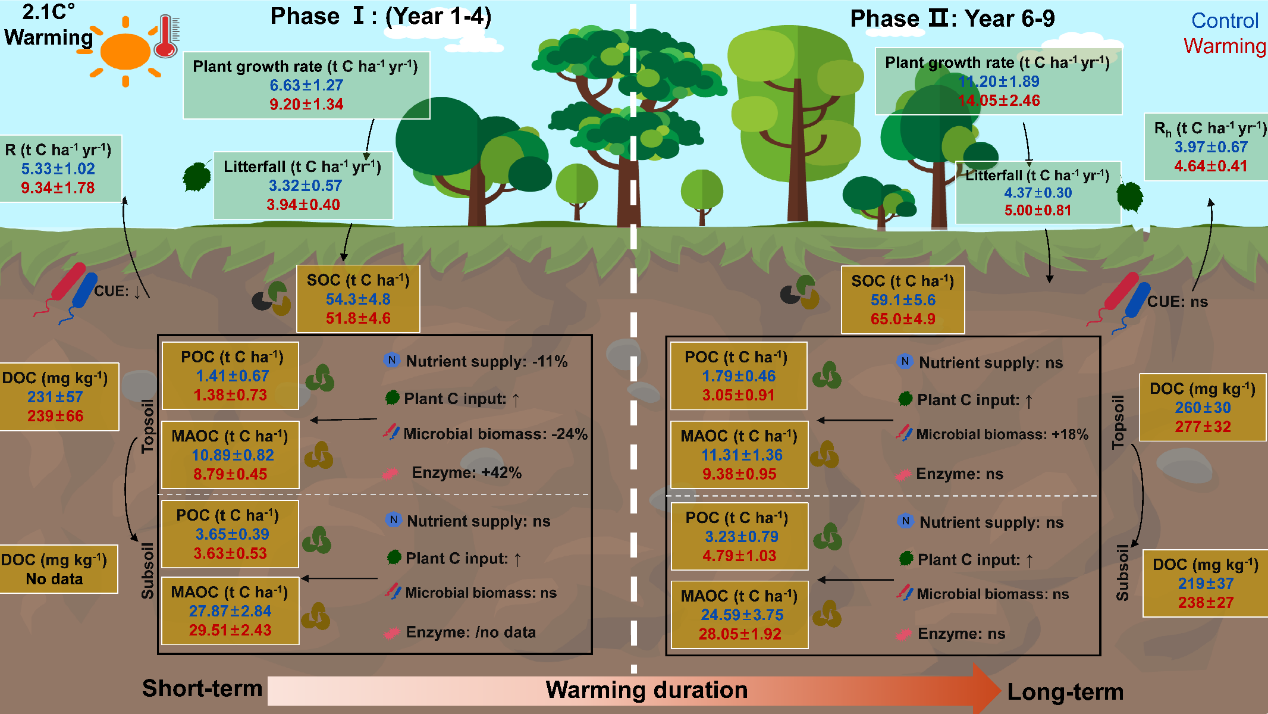
Conceptual diagram of the effect of ecosystem-level warming on soil organic carbon and its’ fractions in a seasonal subtropical forest. (Image by Prof. LIU Juxiu et al)
<関連情報>
- https://english.cas.cn/newsroom/research_news/life/202510/t20251011_1089236.shtml
- https://www.cell.com/one-earth/abstract/S2590-3322(25)00291-X
長期にわたる穏やかな温暖化は土壌炭素循環を変化させるが、亜熱帯林の炭素吸収源は維持される Long-term moderate warming shifts soil carbon cycling but maintains carbon sinks in a subtropical forest
Xujun Liu ∙ Peter B. Reich ∙ David T. Tissue ∙ … ∙ Ze Meng ∙ Qianmei Zhang ∙ Juxiu Liu
One Earth Published:October 6, 2025
DOI:https://doi.org/10.1016/j.oneear.2025.101465
Science for society
Mitigating warming requires both cutting emissions and removing atmospheric carbon (C). Tropical and subtropical forests store large amounts of C in their soils, making them critical allies in this effort. However, chronic warming in these regions may accelerate soil C loss, threatening these natural C sinks. Understanding the fate of soil C in (sub)tropical forests under future warming is crucial for predicting climate feedbacks and guiding effective forest management. Yet, large uncertainties remain due to a lack of warming experiments and insufficient consideration of plant-soil interactions. To address this, we conducted a 9-year ecosystem warming experiment in a subtropical forest and found that moderate warming enhanced soil C through increased plant growth and microbial thermal adjustments, but the higher nutrient demand of plants shifted C accumulation toward plant-derived C. Our findings highlight that plant-soil interactions need to receive more attention in modeling and forest management.
Highlights
- Moderate warming causes two-phase SOC changes: initial loss, later accumulation
- Early SOC loss is driven by MAOC reduction in the topsoil
- Later SOC gains result from POC accumulation across the whole soil profile
- Plant growth and microbial adjustments co-regulate thermal responses of SOC
Summary
The lack of long-term experimental evidence on how multi-phase plant-soil interactions shape soil organic carbon (SOC) responses to warming—especially in (sub)tropical forests—hinders accurate predictions of carbon-climate feedbacks and the development of forest-based mitigation strategies. Here, we report findings from a 9-year passive ecosystem warming experiment (+0°C, +1.0°C, and +2.1°C) in a subtropical forest. We found that SOC exhibited a two-phase response distinct from previous soil-only warming experiments: initial loss (years 1–4) due to reduced topsoil mineral-associated organic carbon, followed by accumulation (years 6–9) attributed to sustained plant carbon inputs and microbial thermal adjustments that increased particulate organic carbon. Our findings indicate that some subtropical forests could continue to accumulate SOC under future moderate warming, albeit with distinct accumulation patterns of different SOC fractions across soil layers. Changes in plant-soil interactions mediating SOC fate under warming should receive increased conceptual and modeling attention moving forward.