2025-10-06 ブラウン大学
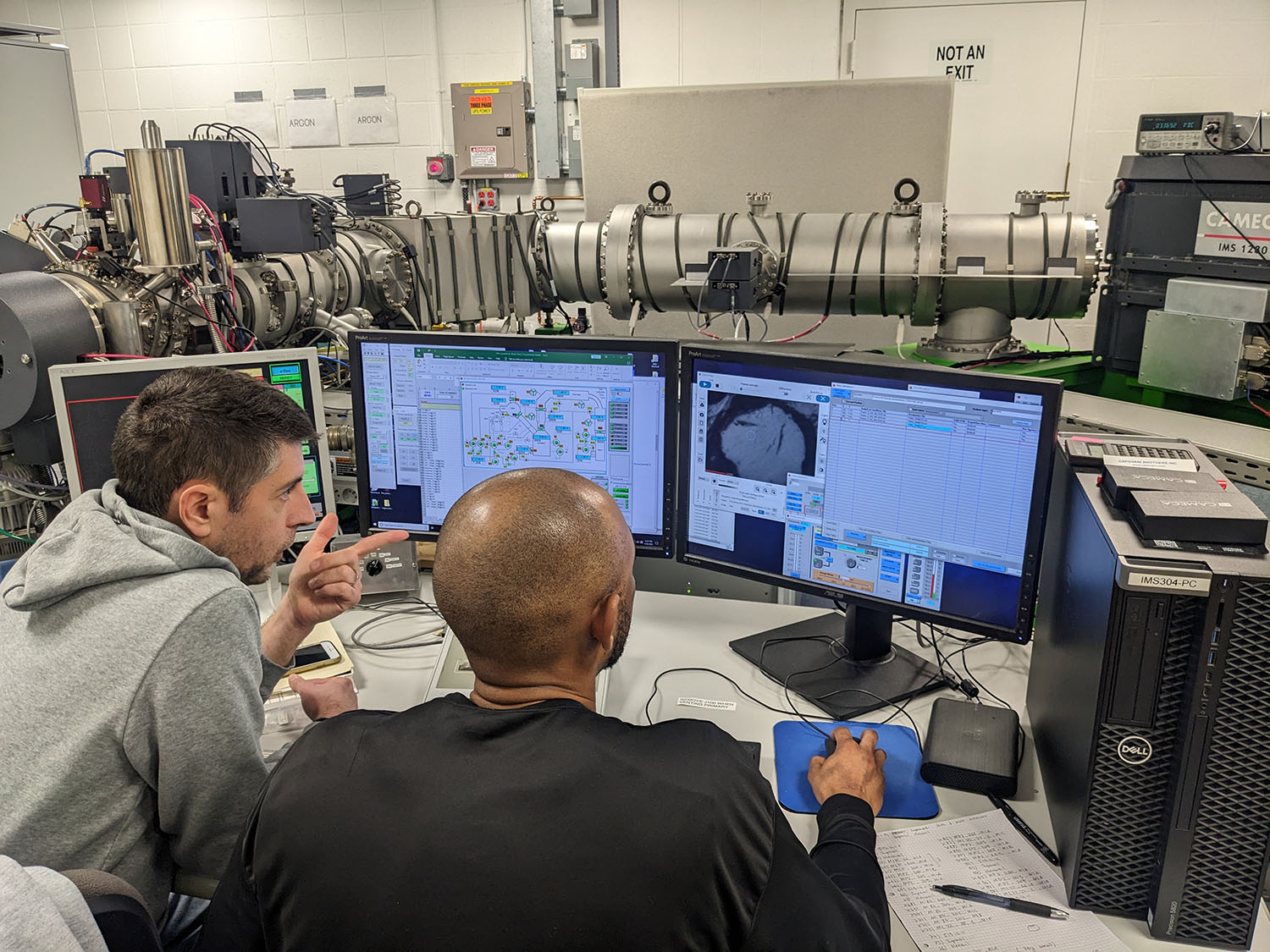 Dottin and co-author Brian Monteleone analyze data from the secondary ion mass spectrometry analysis of Apollo 17 samples.
<関連情報>
- https://www.brown.edu/news/2025-10-06/sulfur-isotopes-apollo-samples
- https://agupubs.onlinelibrary.wiley.com/doi/10.1029/2024JE008834
月のマントルに存在する内因性かつ異質な硫黄 Endogenous, yet Exotic, Sulfur in the Lunar Mantle
J. W. Dottin III, S. B. Simon, C. K. Shearer, J. Benson, H. Fu, J. S. Boesenberg, B. Monteleone, the ANGSA Science Team
Journal of Geophysical Research:Planets Published: 10 September 2025
DOI:https://doi.org/10.1029/2024JE008834
Abstract
In situ sulfur isotope analyses of sulfides found in regolith particles from the recently opened Apollo 17 drive tube 73001/2 reveal variable 34S/32S and 33S/32S that range from that of typical lunar basalts to strongly 34S- and 33S-depleted values (δ34S = −4.1 ± 0.35 to +1.5 ± 0.029; Δ33S = −2.8 ± 0.48 to −0.1 ± 0.27 (2σ)). All Δ33S and δ34S data are positively correlated. The correlation indicates mixing between at least two distinct sources of sulfur in the lunar mantle, one of which is associated with photochemically processed sulfur from a gaseous environment (strongly negative Δ33S). The gaseous precursor and its preservation in endogenous sulfides require that either the sulfur was delivered to the lunar mantle early in its history through unknown processes or it is a remnant of the giant Moon-forming impactor.
Plain Language Summary
The leading hypotheses for the origin of the Moon call for a giant impact event between proto-Earth and a separate impactor (Theia). The efficiency of mixing material among these two planetary bodies remains a subject of debate. Inefficient mixing during this process could leave behind remnants of the composition of the proto-Earth and/or Theia. The sulfur isotope composition of primordial components that survived this impact event could be used to place constraints on early solar nebula chemistry and the distribution of S components throughout the early solar system, as well as the efficiency of mixing during the giant Moon-forming impact event. This study presents anomalous sulfur isotope data from lunar rocks that indicate the presence of either (a) exotic chemistry and crustal recycling during the early evolution of the Moon or (b) material that was not well mixed during the giant Moon-Forming impact event.
Key Points
- Sulfides in regolith particles from the recently opened Apollo 17 drive tube were analyzed for sulfur isotopic and elemental compositions
- Sulfur isotope measurements reveal evidence of multiple lunar mantle sulfur sources
- One mantle source has an unusual sulfur-33 composition that requires delivery during early lunar evolution and inefficient mantle mixing