2025-09-24 清華大学
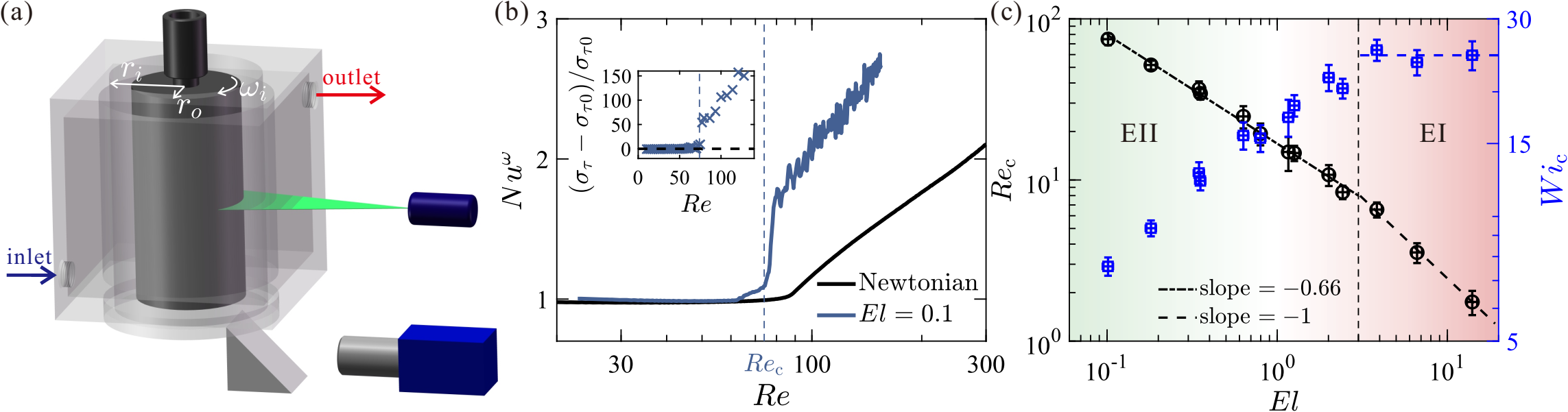
Fig. 1: The transition characteristics of viscoelastic fluids with different elasticities were systematically studied using a custom-designed and built experimental setup.
<関連情報>
弾性乱流と弾性慣性乱流間の連続遷移の実験的証拠 Experimental evidence for the continuous transition between elastic and elastoinertial turbulence
Yi-Bao Zhang, Lu Li, Yaning Fan, +2 , and Chao Sun
Proceedings of the National Academy of Sciences Published:September 17, 2025
DOI:https://doi.org/10.1073/pnas.2505007122
Significance
Viscoelastic fluids are omnipresent in our daily life and engineering. They exhibit two unique chaotic flow states depending on the fluid inertia: one at negligible inertia, while the other at finite inertia. Whether these two states are connected or entirely decoupled remains under active debate. By combining global drag and local velocity measurements, we show that the roles of elasticity and inertia in the flow resistance and the key flow features evolve seamlessly and smoothly from the negligible inertia state to the finite inertia state, thus demonstrating a continuous transition between them. Our findings have important implications for polymer drag reduction and polymer processing, where the interplay between inertia and elasticity plays a crucial role.
Abstract
Elastic turbulence (ET) and elastoinertial turbulence (EIT) of viscoelastic fluids are unique flow states with features distinct from the inertial turbulence of Newtonian fluids. Whether these two states are connected or entirely decoupled remains controversial. We here resolve this controversy by providing experimental evidence of a continuous transition between ET and EIT in Taylor-Couette flow. Through experimentally quantifying the roles of elasticity and inertia in flow stability, we find that elasticity is the primary driving mechanism for both elastic and elastoinertial instabilities, and inertia plays a secondary role in the latter. Remarkably, the critical condition for these instabilities can be described by a unified function derived from stability analysis, revealing that the transition between elastic instability to elastoinertial instability is continuous. Moreover, we show that the flow structures and the energy spectrum evolve seamlessly from ET to elasticity-dominated EIT, transitional EIT, and inertia-modulated EIT, with inertia playing an increasingly important role in the last three regimes. Our results offer insights into the fundamental nature of turbulence in viscoelastic flows and would have implications for applications involving drag reduction and polymer processing.