2025-09-03 バーミンガム大学
<関連情報>
- https://www.birmingham.ac.uk/news/2025/global-methane-levels-continue-rising-as-planet-heats-up
- https://www.nature.com/articles/s41467-025-63383-5
1990-2023年の地球規模メタンフットプリントの成長と駆動要因 Global methane footprints growth and drivers 1990-2023
Yuli Shan,Kailan Tian,Ruoqi Li,Yuru Guan,Jiamin Ou,Dabo Guan & Klaus Hubacek
Nature Communications Published:03 September 2025
DOI:https://doi.org/10.1038/s41467-025-63383-5
Abstract
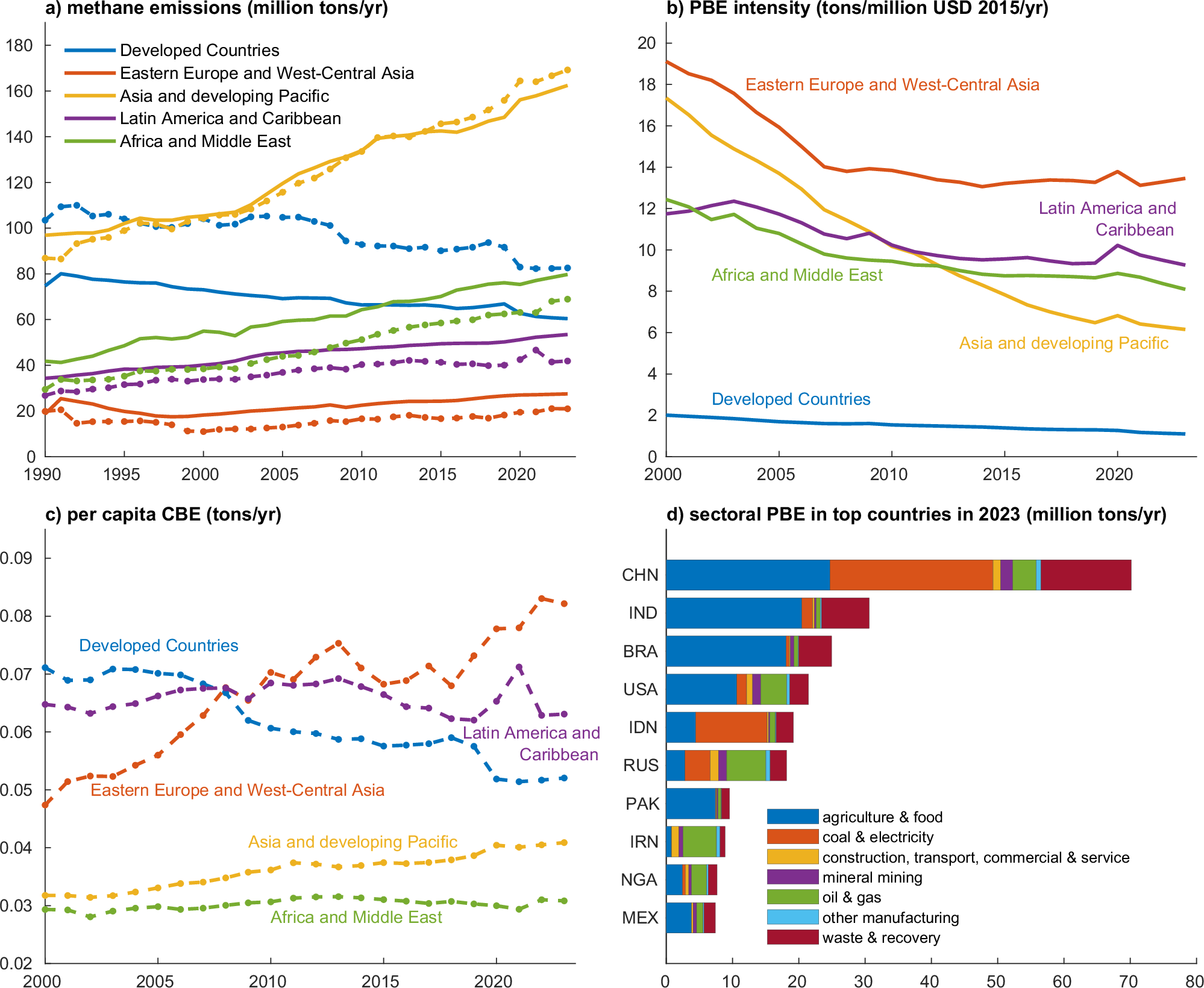
Methane has been identified as the second-largest contributor to climate change, accounting for approximately 30% of global warming. Countries have established targets and are implementing various measures to curb methane emissions. However, our understanding of the trends in methane emissions and their drivers remains limited, particularly from a consumption perspective (i.e. accounting for all emissions along the entire global supply chain). This study investigates the most recent dynamics of methane emissions across 120 sectors from both production and consumption viewpoints in 164 countries. It also discusses the status of decoupling of production- and consumption-based methane emissions from economic growth. Our results indicate that there is no foreseeable slowdown in the momentum of global methane emissions growth. Only a few developed countries have managed to reduce both production- and consumption-based emissions while maintaining economic growth (i.e., strong decoupling) during the observed period (1990-2023). Global trade accounts for approximately 30% of global methane emissions, but major trade patterns are shifting from North-North and North-South to South-South countries, reflecting the increasing participating of developing countries in global supply chains. The study further reveals the changing drivers of global methane emissions from 1998 to 2023 in five-year intervals. It identifies that the reduction in emission coefficient (i.e., emissions per unit of output), driven by advancements in improved energy efficiency and cleaner production technologies, is the main determinant for reducing emissions over the observation period, partly offsetting the increasing effects from growth of final demand. Changes in demand structure have played a considerable role in the increase of emissions since 2008. This study enhances our understanding of the changes and drivers of methane emissions and supports countries in incorporating methane emissions into their climate mitigation strategies.