
2025-08-28 英国研究イノベーション機構(UKRI)
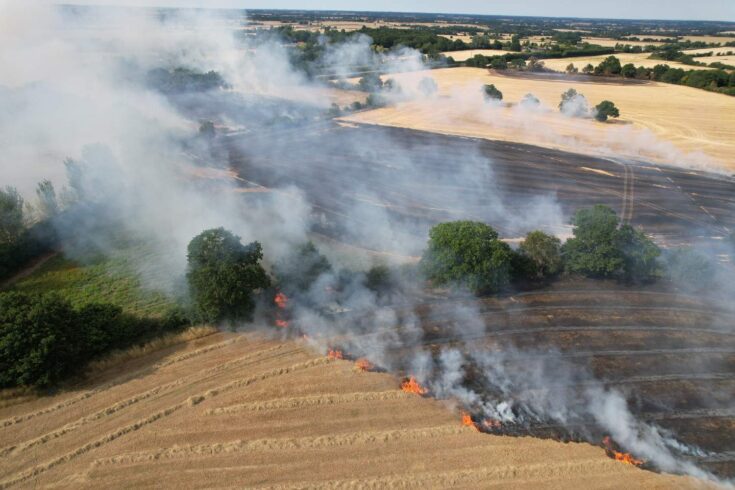
Top image: Credit: Steve Bateman, iStock, Getty Images Plus via Getty Images
<関連情報>
- https://www.ukri.org/news/wildfire-chemical-toxic-to-humans-lingers-longer-in-clouds/
- https://www.pnas.org/doi/10.1073/pnas.2504123122
毒性汚染物質が光分解を回避するメカニズム:水溶液中UV励起2,4-ジニトロフェノールの緩和経路 How a toxic pollutant avoids photodegradation: Relaxation pathways of UV-excited 2,4-dinitrophenol in aqueous solution
Hallam J. M. Greene, Deborin Ghosh, Igor V. Sazanovich, +3 , and Andrew J. Orr-Ewing
Proceedings of the National Academy of Sciences Published:August 6, 2025
Significance
2,4-Dinitrophenol (DNP) is a toxic and polluting organic chemical which is released into the environment by both natural processes such as wildfires and by industrial and agricultural practices. It absorbs solar UV-A and UV-B radiation that reaches the lower atmosphere and the Earth’s surface. When dissolved in water, such as in mist or cloud droplets, DNP resists degradation by this solar radiation, although the reasons are unclear. The current study shows that in aqueous solution, deactivation of UV-photoexcited molecules is achieved efficiently by at least two competing pathways, with timescales that differ by more than 4 orders of magnitude. Because of these efficient excited-state relaxation mechanisms, environmental DNP loss by reaction with OH radicals can outweigh solar photolysis.
Abstract
Nitroaromatic compounds are pollutants emitted from biomass burning and fossil fuel combustion. They are a major component of brown carbon aerosols, affecting radiative forcing in the lower atmosphere. Among these species, 2,4-dinitrophenol (DNP) is toxic to both plants and animals and is resistant to photodegradation when dissolved in water, such as in aqueous atmospheric aerosols. To understand this environmental photostability of DNP, the photochemistry of near-UV excited DNP in aqueous solution is investigated using transient absorption spectroscopy and time-resolved infrared spectroscopy, seamlessly spanning fs – μs timescales to reveal the pathways following photoexcitation. Building upon our understanding of simpler nitroaromatic species, and using linear-response time-dependent density functional theory (LR-TDDFT) to provide a framework for the interpretation of the results, the complex photochemistry of this species is unraveled. The majority of DNP relaxes within the singlet manifold, via intersection seams between the S1 potential energy surface and the S0 state, on timescales shorter than the few-picosecond limits of vibrational cooling. A second ground-state recovery pathway involves intersystem crossing from a region of the S1 surface with nπ* electronic character into the triplet manifold, deprotonation to form the nitrophenolate anion and reprotonation in solution. Branching ratios between these pathways are influenced by the excitation wavelength. In aqueous solution, DNP will also exist as dinitrophenolate anions which, when photoexcited in the near-UV, undergo direct electronic relaxation on sub-ps timescales. Combinations of these pathways result in complete S0 recovery, allowing this toxic species to resist solar photodegradation when dissolved in aqueous atmospheric aerosols.

