2025-08-20 オックスフォード大学
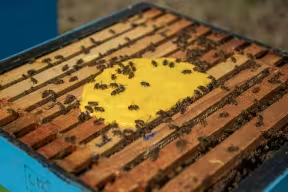
A pollen substitute in a honeybee colony, Oxford Bee Lab. Credit: Caroline Wood
<関連情報>
- https://www.ox.ac.uk/news/2025-08-20-saving-bees-superfoods-new-engineered-supplement-found-boost-colony-reproduction
- https://www.nature.com/articles/s41586-025-09431-y
遺伝子組み換え酵母はミツバチにとって希少だが不可欠な花粉ステロールを提供するEngineered yeast provides rare but essential pollen sterols for honeybees
Elynor Moore,Raquel T. de Sousa,Stella Felsinger,Jonathan A. Arnesen,Jane D. Dyekjær,Dudley I. Farman,Rui F. S. Gonçalves,Philip C. Stevenson,Irina Borodina & Geraldine A. Wright
Nature Published:20 August 2025
DOI:https://doi.org/10.1038/s41586-025-09431-y
Abstract
Honeybees are important crop pollinators, but they increasingly face pollen starvation as a result of agricultural intensification and climate change1. Frequent flowering dearth periods and high-density rearing conditions weaken colonies, which often leads to their demise2. Beekeepers provide colonies with pollen substitutes, but these feeds do not sustain brood production because they lack essential sterols found in pollen3,4. Here we describe a technological advance in honeybee nutrition with wide-reaching impacts on global food security. We first measured the quantity and proportion of sterols present in honeybee tissues. Using this information, we genetically engineered a strain of the oleaginous yeast Yarrowia lipolytica to produce a mixture of essential sterols for bees and incorporated this yeast strain into an otherwise nutritionally complete diet. Colonies exclusively fed with this diet reared brood for significantly longer than those fed diets without suitable sterols. The use of this method to incorporate sterol supplements into pollen substitutes will enable honeybee colonies to produce brood in the absence of floral pollen. Optimized diets created using this yeast strain could also reduce competition between bee species for access to natural floral resources and stem the decline in wild bee populations.