
2025-08-13 シカゴ大学(UChicago)
 This artist’s concept depicts what planet TRAPPIST-1 d might look like as it passes in front of its turbulent star, with other members of the closely packed system shown in the background.Illustration by NASA, ESA, CSA, Joseph Olmsted (STScI).
<関連情報>
- https://news.uchicago.edu/story/scientists-rule-out-earth-atmosphere-nearby-exoplanet-trappist-1-d
- https://iopscience.iop.org/article/10.3847/1538-4357/adf207
温帯岩石地球外惑星 TRAPPIST-1 における潜在的な二次大気の厳密な制限 d Strict Limits on Potential Secondary Atmospheres on the Temperate Rocky Exo-Earth TRAPPIST-1 d
Caroline Piaulet-Ghorayeb, Björn Benneke, Martin Turbet, Keavin Moore, Pierre-Alexis Roy, Olivia Lim, René Doyon, Thomas J. Fauchez, Loïc Albert, Michael Radica,…
The Astrophysical Journal Published: 2025 August 13
DOI:10.3847/1538-4357/adf207
Abstract
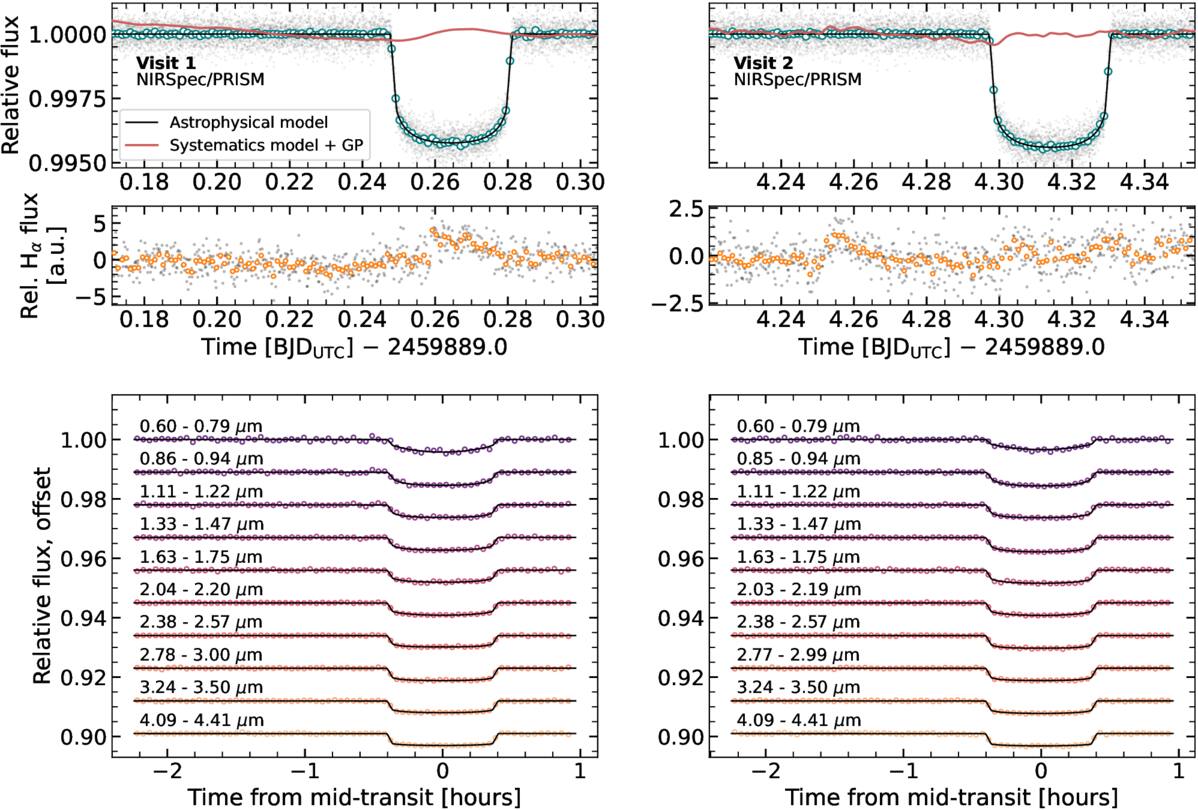
The nearby TRAPPIST-1 system, with its seven small rocky planets orbiting a late-type M8 star, offers an unprecedented opportunity to search for secondary atmospheres on temperate terrestrial worlds. In particular, the 0.8 R⊕TRAPPIST-1 d lies at the edge of the habitable zone (Teq,A=0.3 = 262 K). Here we present the first 0.6–5.2 μm NIRSpec/PRISM transmission spectrum of TRAPPIST-1 d from two transits with JWST. We find that stellar contamination from unocculted bright heterogeneities introduces 500–1000 ppm visit-dependent slopes, consistent with constraints from the out-of-transit stellar spectrum. Once corrected, the transmission spectrum is flat within ±100–150 ppm, showing no evidence for a haze-like slope or molecular absorption despite NIRSpec/PRISM’s sensitivity to CH4, H2O, CO, SO2, and CO2. Our observations exclude clear, hydrogen-dominated atmospheres with high confidence (>3σ). We leverage our constraints on even trace amounts of CH4, H2O, and CO2 to further reject high mean molecular weight compositions analogous to a haze-free Titan, a cloud-free Venus, early Mars, and both Archean Earth and a cloud-free modern Earth scenario (>95% confidence). If TRAPPIST-1 d retains an atmosphere, it is likely extremely thin or contains high-altitude aerosols, with water cloud formation at the terminator predicted by 3D global climate models. Alternatively, if TRAPPIST-1 d is airless, our evolutionary models indicate that TRAPPIST-1 b, c, and d must have formed with ≲4 Earth oceans of water, though this would not preclude atmospheres on the cooler habitable-zone planets TRAPPIST-1 e, f, and g.

