2026-01-14 コロンビア大学
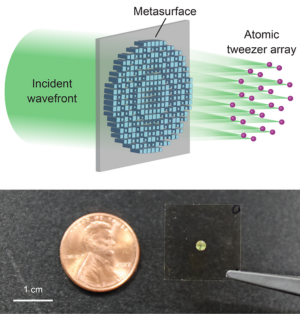
Top: Schematic of how a metasurface shapes a single beam of light into multiple tightly focused beams in a single step. These beams form a series of optical tweezers to trap individual atoms into arrays with arbitrary geometry. Bottom: A metasurface compared to a penny. Credit: Will and Yu labs, Columbia University
<関連情報>
- https://quantum.columbia.edu/news/neutral-atom-arrays-are-rapidly-emerging-quantum-computing-platform-these-columbia-researchers
- https://www.nature.com/articles/s41586-025-09961-5
メタ表面光ピンセットアレイにおける単一原子の捕捉 Trapping of single atoms in metasurface optical tweezer arrays
Aaron Holman,Yuan Xu,Ximo Sun,Jiahao Wu,Mingxuan Wang,Zezheng Zhu,Bojeong Seo,Nanfang Yu & Sebastian Will
Nature Published:14 January 2026
DOI:https://doi.org/10.1038/s41586-025-09961-5
Abstract
Optical tweezer arrays have emerged as a key experimental platform1,2 for quantum computation3,4, quantum simulation5,6 and quantum metrology7,8, enabling unprecedented levels of control over single atoms and molecules. The ability to scale such arrays has become a defining challenge. Typically, optical tweezer arrays are generated using acousto-optic deflectors or liquid-crystal spatial light modulators. Fundamental limitations in optical resolution have constrained array sizes to about 10,000 traps9. Metasurfaces10,11, planar photonic devices comprising millions of subwavelength pixels, provide an intriguing alternative for the generation of optical tweezer arrays12. Here we demonstrate the trapping of single strontium atoms in optical tweezer arrays generated via holographic metasurfaces. We realize two-dimensional arrays with more than 100 single atoms, arranged in arbitrary geometries with trap spacings as small as 1.5 μm. The arrays have a high uniformity in terms of trap depth, trap frequency and positional accuracy, rivalling or surpassing existing approaches. This is enabled by highly efficient holographic metasurfaces fabricated from high-refractive-index materials, silicon-rich silicon nitride and titanium dioxide. Through analytical and numerical methods, we find that the subwavelength pixel sizes of these metasurfaces allow scaling of tweezer arrays far beyond current capabilities. As a demonstration, we realize an optical tweezer array with 360,000 traps. These advances overcome a critical barrier to realizing scalable neutral-atom quantum technologies.