2025-12-15 中国科学院(CAS)
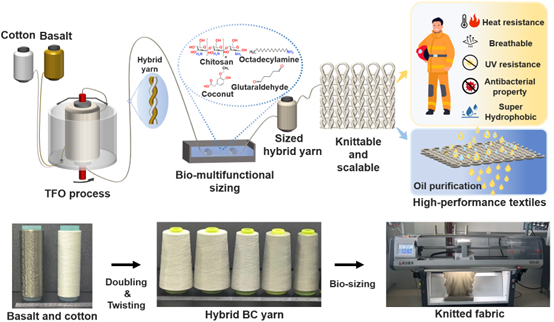
Schematic diagram showing the experimental design and developed hybrid yarns and fabrics. (Image by Prof. MA Pengcheng’s team)
<関連情報>
- https://english.cas.cn/newsroom/research_news/chem/202512/t20251216_1137166.shtml
- https://www.sciencedirect.com/science/article/abs/pii/S2452213925003869
高性能繊維向けの編みやすい多機能玄武岩/綿複合糸 Knittable and multifunctional basalt/cotton composite yarn for high-performance textiles
Desalegn Atalie, Xiong-Yu Xi, Akram Yasin, Dan Xing, Ming-Cheng Gao, Ze-Shi Guo, Meng Li, Peng-Cheng Ma
Composites Communications Available online: 1 November 2025
DOI:https://doi.org/10.1016/j.coco.2025.102633
Highlights
- Knittable basalt/cotton composite yarn was developed with a bio-based polymer.
- The bio-sizing enhancement increases tenacity by 35.5 %, elongation by 33.9 %.
- Basalt fiber enhanced the thermal and fire resistance of the knitted fabrics.
- Fabric tensile & burst strength improved by104.6 % & 206 % with 98 % UV resistance.
- Bio-polymer imparts durability, hydrophobicity, and antibacterial properties.
Abstract
High-performance textiles are crucial in numerous sectors, yet existing materials often fail to meet the dual requirements of sustainability and multifunctionality. Basalt fiber, derived from natural rock through an environmentally friendly process, is renowned for its excellent strength, high-temperature resistance, and chemical inertness. However, its intrinsic brittleness brings great challenges for knitting applications. This study presents a novel and scalable process to develop basalt/cotton (BC) composite yarn for high-performance textile applications. The yarn is obtained using a sustainable manufacturing approach that combines the twist-for-one (TFO) technique with a bio-based sizing. The bio-based sizing not only enhances the mechanical properties of the prepared yarn, yielding a 35.6 % increase in tenacity and a 33.9 % improvement in elongation compared to the unsized BC hybrid yarn, but also imparts several key functionalities to the fabrics. Specifically, knitted fabrics possess a multi-functional profile, integrating superhydrophobicity with a water contact angle of 152.4o, robust ultraviolet protection factor of 265.3, and potent antibacterial activity against S.aureus (99.1 %) and E.coli (97.1 %). Furthermore, the fabrics exhibit a notable 206 % stretchability and excellent tactile comfort. The incorporation of basalt fiber significantly improves the thermal stability of the cotton in BC hybrid fabric, as confirmed by the increased decomposition temperature at 5 % weight loss from 295 °C to 335 °C. These attributes highlight the promising potential of the BC hybrid yarn for sustainable and high-performance textile applications.