2025-12-18 京都大学
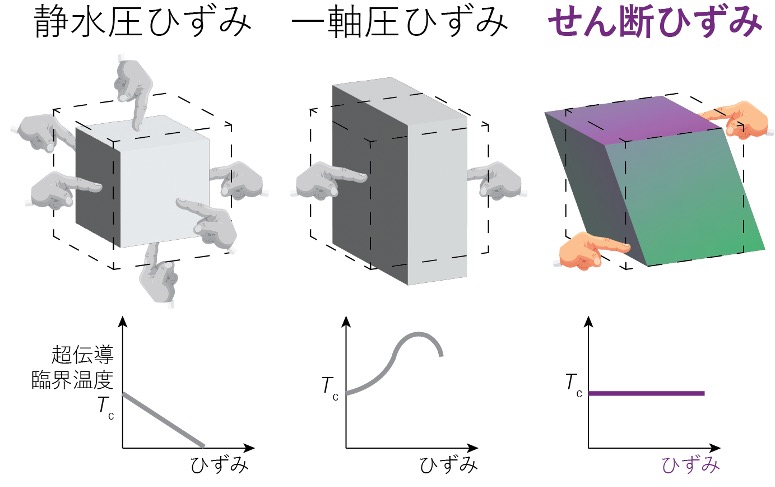
せん断ひずみでは変化しない Sr₂RuO₄のTc。Sr₂RuO₄では、静水圧は超伝導転移温度Tcを低下させ、逆に一軸圧はTcを上昇させることが知られている。本研究では、せん断ひずみはTcを変化させないという、超伝導機構の理解に重要で興味深い結果が得られた。(画像クレジット:Giordano Mattoni)
<関連情報>
- https://www.kyoto-u.ac.jp/ja/research-news/2025-12-18-1
- https://www.kyoto-u.ac.jp/sites/default/files/2025-12/Web_Mattoni_NatCommun2025_News_JP_v7%20%281%29-e96e35b2a64639cc9d713a9aec357ff1.pdf
- https://www.nature.com/articles/s41467-025-67307-1
Sr2 RuO4におけるせん断ひずみと超伝導の間に結合が存在しないことを示す直接的な証拠 Direct evidence for the absence of coupling between shear strain and superconductivity in Sr2RuO4
Giordano Mattoni,Thomas Johnson,Atsutoshi Ikeda,Shubhankar Paul,Jake Bobowski,Manfred Sigrist & Yoshiteru Maeno
Nature Communications Published:16 December 2025
DOI:https://doi.org/10.1038/s41467-025-67307-1
Abstract
The superconducting symmetry of Sr2RuO4 has been intensely debated for many years. A crucial controversy recently emerged between shear-mode ultrasound experiments, which suggest a two-component order parameter, and some uniaxial pressure experiments that suggest a one-component order parameter. To resolve this controversy, we use a new approach to directly apply three different kinds of shear strain to single crystals of Sr2RuO4 and investigate the coupling to superconductivity. After characterising the strain by optical imaging, we observe variations of the transition temperature Tc smaller than 10 mK%−1 as measured by low-frequency magnetic susceptibility, indicating that shear strain has little to no coupling to superconductivity. Our results are consistent with a one-component order parameter model, but such a model cannot consistently explain other experimental evidence such as time-reversal symmetry breaking, superconducting domains, and horizontal line nodes, thus calling for alternative interpretations.