2025-12-16 マックス・プランク研究所
<関連情報>
- https://www.mpg.de/25882013/bronze-age-dna-from-calabria-reveals-a-distinct-mountain-community
- https://www.nature.com/articles/s42003-025-09194-2
考古遺伝学は南イタリアの青銅器時代のコミュニティの人口統計と極端な親の近親婚を再現する Archaeogenetics reconstructs demography and extreme parental consanguinity in a Bronze Age community from Southern Italy
Francesco Fontani,Felice Larocca,Elisabetta Cilli,Rocco Iacovera,Adam Jon Andrews,Adriana Latorre,Fabiola Arena,Rossella Veneziano,Lucio Calcagnile,Gianluca Quarta,Harald Ringbauer,Philipp W. Stockhammer,Johannes Krause,Donata Luiselli & Alissa Mittnik
Communications Biology Published:15 December 2025
DOI:https://doi.org/10.1038/s42003-025-09194-2
Abstract
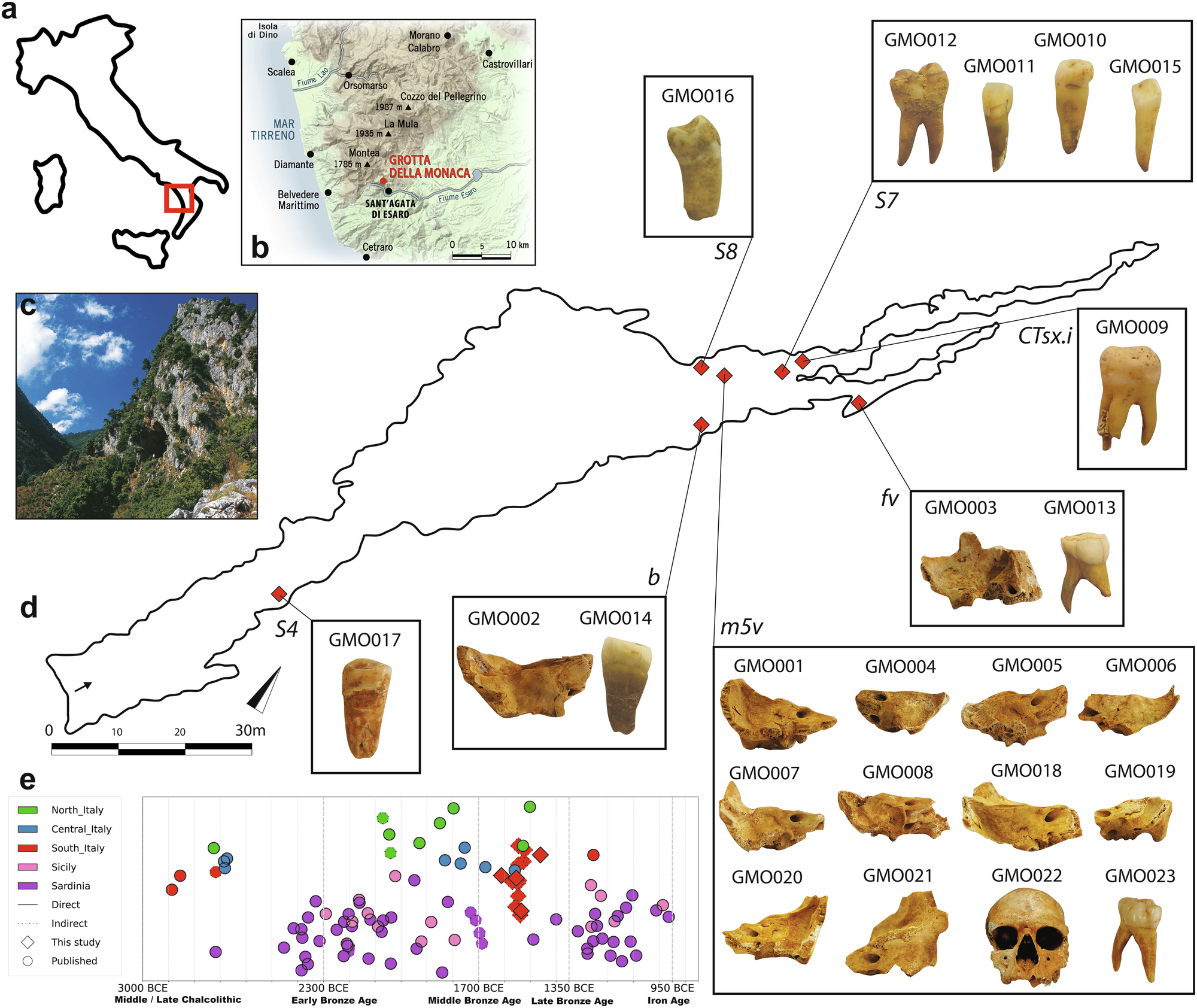
Given its geographic location and unique history of contacts and migrations, Calabria is a core region to investigate the genetic traces of some of the numerous prehistoric demographic events in the Central Mediterranean. However, little is known regarding the ancient populations of the region before Greek colonization, reflecting gaps in the archaeological knowledge of the territory and scarcity of genetic data. Here, we analysed genome-wide data from the Middle Bronze Age site of Grotta della Monaca (1780-1380 ca. BCE) to fill these gaps and decipher funerary practices, social organization, biological kinship ties, and demographic shifts in Southern Italy during the Bronze Age. The community shows closer genetic affinity to Early Bronze Age Sicilians than to contemporaneous populations from the Italian peninsula. However, unlike contemporary Sicilian individuals, they lack eastern genetic influences, suggesting distinct ancestral trajectories and interaction networks among Bronze Age populations. Further, we suggest that burial practices were structured according to the sex and kinship relationships of the deceased. To the best of our knowledge, our data showcase the first case reported in archaeological literature of a parent-offspring incestuous union, an extreme case that we attempt to frame into the demographic landscape of prehistoric communities of Bronze Age Southern Italy.