

2025-10-29 カリフォルニア大学サンタバーバラ校 (UCSB)
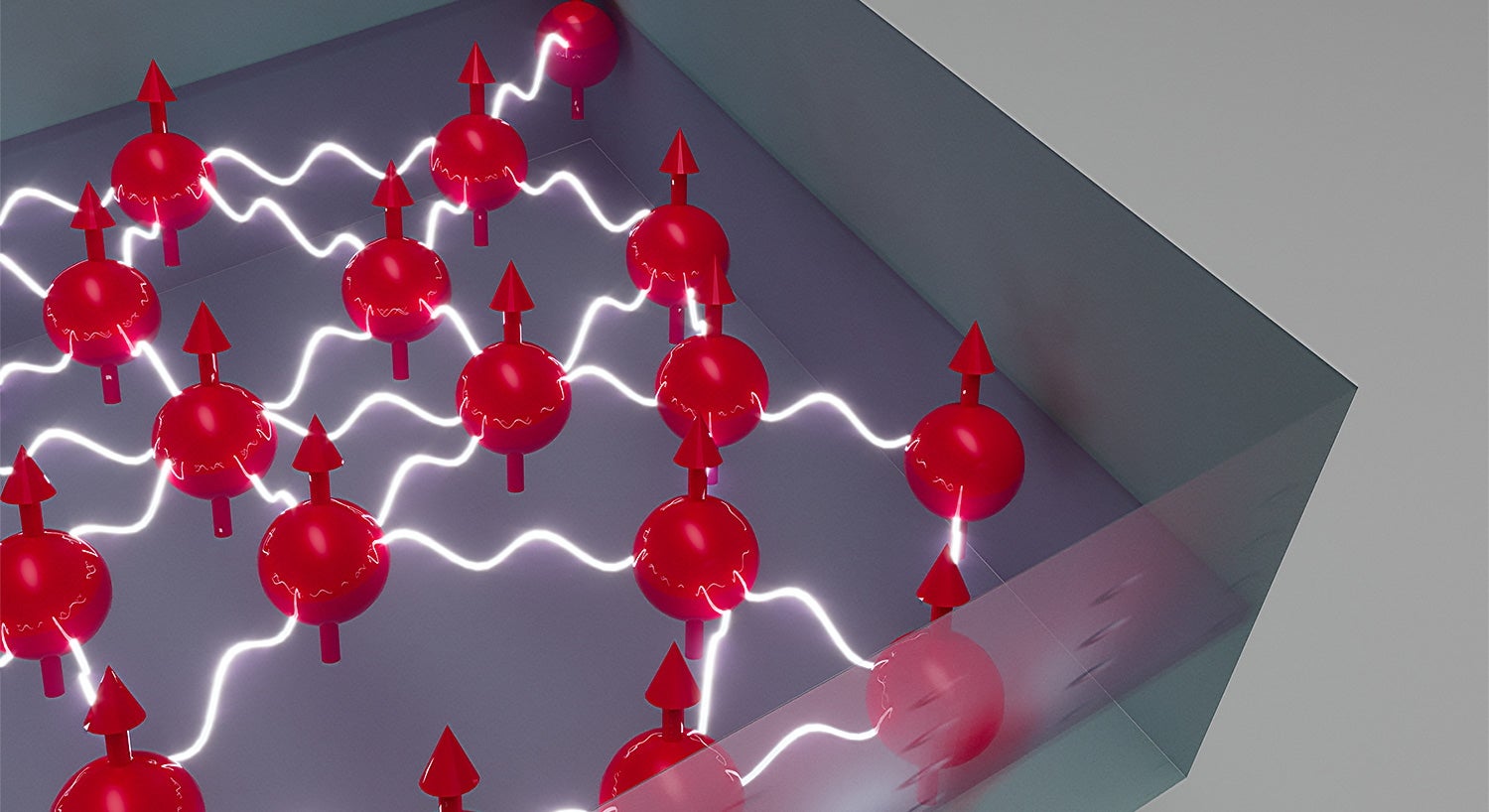
Photo Credit:Illustration by Brian Long. Artist’s concept illustration showing a two-dimensional collection of interacting spins in a diamond lattice.
<関連情報>
- https://news.ucsb.edu/2025/022189/new-dimension-spin-qubits-diamond
- https://www.nature.com/articles/s41586-025-09524-8
- https://arxiv.org/abs/2503.14598
- https://journals.aps.org/prx/abstract/10.1103/PhysRevX.15.021035
ダイヤモンド中の窒素空孔中心集団におけるスピンスクイージング Spin squeezing in an ensemble of nitrogen–vacancy centres in diamond
Weijie Wu,Emily J. Davis,Lillian B. Hughes,Bingtian Ye,Zilin Wang,Dominik Kufel,Tasuku Ono,Simon A. Meynell,Maxwell Block,Che Liu,Haopu Yang,Ania C. Bleszynski Jayich & Norman Y. Yao
Nature Published:01 October 2025
DOI:https://doi.org/10.1038/s41586-025-09524-8
Abstract
Spin-squeezed states provide a seminal example of how the structure of quantum mechanical correlations can be controlled to produce metrologically useful entanglement1,2,3,4,5,6,7. These squeezed states have been demonstrated in a wide variety of quantum systems ranging from atoms in optical cavities to trapped ion crystals8,9,10,11,12,13,14,15,16. By contrast, despite their numerous advantages as practical sensors, spin ensembles in solid-state materials have yet to be controlled with sufficient precision to generate targeted entanglement such as spin squeezing. Here we report the experimental demonstration of spin squeezing in a solid-state spin system. Our experiments are performed on a strongly interacting ensemble of nitrogen–vacancy colour centres in diamond at room temperature, and squeezing (−0.50 ± 0.13 dB) below the noise of uncorrelated spins is generated by the native magnetic dipole–dipole interaction between nitrogen–vacancy centres. To generate and detect squeezing in a solid-state spin system, we overcome several challenges. First, we develop an approach, using interaction-enabled noise spectroscopy, to characterize the quantum projection noise in our system without directly resolving the spin probability distribution. Second, noting that the random positioning of spin defects severely limits the generation of spin squeezing, we implement a pair of strategies aimed at isolating the dynamics of a relatively ordered sub-ensemble of nitrogen–vacancy centres. Our results open the door to entanglement-enhanced metrology using macroscopic ensembles of optically active spins in solids.
多体動力学の非対称時間反転による固体量子センサーにおける信号増幅 Signal amplification in a solid-state quantum sensor via asymmetric time-reversal of many-body dynamics
Haoyang Gao, Leigh S. Martin, Lillian B. Hughes, Nathaniel T. Leitao, Piotr Put, Hengyun Zhou, Nazli U. Koyluoglu, Simon A. Meynell, Ania C. Bleszynski Jayich, Hongkun Park, Mikhail D. Lukin
arxiv Submitted on 18 Mar 2025
DOI:https://doi.org/10.48550/arXiv.2503.14598
Abstract
Electronic spins of nitrogen vacancy (NV) centers in diamond constitute a promising system for micro- and nano-scale magnetic sensing, due to their operation under ambient conditions, ease of placement in close proximity to sensing targets, and biological compatibility. At high densities, the electronic spins interact through dipolar coupling, which typically limits but can also potentially enhance sensing performance. Here we report the experimental demonstration of many-body signal amplification in a solid-state, room temperature quantum sensor. Our approach utilizes time-reversed two-axis-twisting interactions, engineered through dynamical control of the quantization axis and Floquet engineering in a two-dimensional ensemble of NV centers. Strikingly, we observe that the optimal amplification occurs when the backward evolution time equals twice the forward evolution time, in sharp contrast to the conventional Loschmidt echo. These observations can be understood as resulting from an underlying time-reversed mirror symmetry of the microscopic dynamics, providing key insights into signal amplification and opening the door towards entanglement-enhanced practical quantum sensing.
(111)配向ダイヤモンドにおける強く相互作用する二次元双極子スピン集団 Strongly Interacting, Two-Dimensional, Dipolar Spin Ensembles in (111)-Oriented Diamond
Lillian B. Hughes, Simon A. Meynell, Weijie Wu, Shreyas Parthasarathy, Lingjie Chen, Zhiran Zhang, Zilin Wang, Emily J. Davis, Kunal Mukherjee et al.
Physical Review X Published: 30 April, 2025
DOI: https://doi.org/10.1103/PhysRevX.15.021035
Abstract
Systems of spins with strong dipolar interactions and controlled dimensionality enable new explorations in quantum sensing and simulation. In this work, we investigate the creation of strong dipolar interactions in a two-dimensional ensemble of nitrogen-vacancy (NV) centers generated via plasma-enhanced chemical vapor deposition on (111)-oriented diamond substrates. We find that diamond growth on the (111) plane yields high incorporation of spins, both nitrogen and NV centers, where the density of the latter is tunable via the miscut of the diamond substrate. Our process allows us to form dense, preferentially aligned, 2D NV ensembles with volume-normalized ac sensitivity down to ac=810 pT μm3/2 Hz−1/2. Furthermore, we show that (111) affords maximally positive dipolar interactions among a 2D NV ensemble, which is crucial for leveraging dipolar-driven entanglement schemes and exploring new interacting spin physics.

