2025-08-12 レンセラー工科大学 (RPI)
ChatGPT:
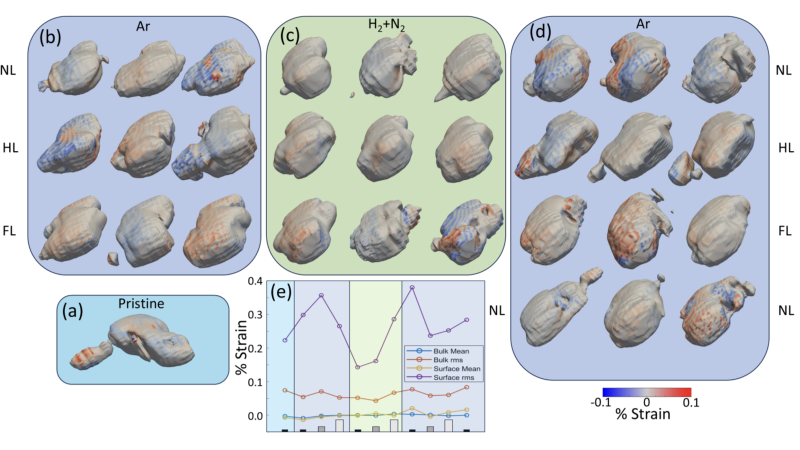
Visualization of strain and cracking in a bismuth tungstate nanoparticle under various environmental conditions. (Fohtung et al., Real-Time Tracking of Nanoscale Morphology and Strain Evolution in Bi2WO6 via Operando Coherent X-Ray Imaging, Advanced Materials 2025)
<関連情報>
- https://news.rpi.edu/2025/08/12/rpi-researchers-join-expertise-frontier-light-and-materials-research
- https://advanced.onlinelibrary.wiley.com/doi/10.1002/adma.202504445?af=R
- https://advanced.onlinelibrary.wiley.com/doi/10.1002/adma.202415231
Bi₂WO₆におけるナノスケール形態とひずみ進化のリアルタイム追跡:オペランドコヒーレントX線イメージングによる Real-Time Tracking of Nanoscale Morphology and Strain Evolution in Bi2WO6 via Operando Coherent X-Ray Imaging
Jackson Anderson, Nimish P. Nazirkar, Atoumane Ndiaye, Julie Barringer, Viet Tran, Pascal Bassène, Wonsuk Cha, Jie Jiang, Jian Shi, Ross Harder, Moussa N’Gom, Edwin Fohtung
Advanced Materials Published: 24 June 2025
DOI:https://doi.org/10.1002/adma.202504445
Abstract
Nanostructuring photocatalytic and catalytic materials substantially increases the surface-to-volume ratio, thereby exposing a greater number of active sites essential for enhanced catalytic efficiency. However, optimizing these efficiencies requires the non-destructive, operando interrogation of individual nanocrystals under realistic catalytic conditions—a capability that has long remained elusive. Here, this challenge is addressed by reporting three-dimensional imaging of defects, crystal morphology, and strain dynamics in individual Bi2WO6 (BWO) nanoflakes using Bragg coherent diffractive imaging (BCDI) under operando temperature, gas, and light-driven conditions. It is demonstrated that maintaining a constant temperature of 40°C thermally activates charge carriers, likely enhancing their mobility and reducing recombination rates. Furthermore, an Argon (Ar) gas flow stabilizes the reaction environment, while a mixed Hydrogen–Nitrogen (H2 + N2) flow induces a hydrogen-triggered semiconducting-to-metallic (SM) electronic phase transition accompanied by a structural transformation, as supported by density functional theory (DFT) calculations. Both DFT and BCDI analyses reveal that during the SM phase transition, a new structural phase nucleates near defects and propagates inhomogeneously. Notably, the onset of nanoscale cracking is observed, driven by localized strain accumulation and environmental cycling, which increases surface area and potentially introduces new reactive sites. These findings illustrate that combining advanced nanostructuring with operando imaging techniques can provide critical insights into the local structural features that govern photocatalytic performance, paving the way for the rational design of next-generation photocatalytic materials.
ねじれた光を用いたフェロエレクトリックなトポロジカル極性構造の操作 Manipulating Ferroelectric Topological Polar Structures with Twisted Light
Nimish P. Nazirkar, Viet Tran, Pascal Bassène, Atoumane Ndiaye, Julie Barringer, Jie Jiang, Wonsuk Cha, Ross Harder, Jian Shi, Moussa N’Gom, Edwin Fohtung
Advanced Materials Published: 06 June 2025
DOI:https://doi.org/10.1002/adma.202415231
Abstract
The dynamic control of non-equilibrium states represents a central challenge in condensed matter physics. While intense terahertz fields drive metal-insulator transitions and ferroelectricity via soft phonon modes, recent theory suggests that twisted light with orbital angular momentum (OAM) offers a distinct route to manipulate ferroelectric order and stabilize topological excitations including skyrmions, vortices, and Hopfions. Control of ferroelectric polarization in quasi-2D CsBiNb2O7 (CBNO) is demonstrated using non-resonant twisted ultra-violet (UV) light (375 nm, 800 THz). Combining in situ X-ray Bragg coherent diffractive imaging (BCDI), twisted optical Raman spectroscopy, and density functional theory (DFT), three-dimensional (3D) ionic displacements, strain fields, and polarization changes are resolved in single crystals. Operando measurements reveal light-induced strain hysteresis under twisted light–a hallmark of nonlinear, history-dependent ferroelastic switching driven by OAM. Discrete, irreversible domain transitions emerge as the topological charge ℓ is cycled, stabilizing non-trivial domain textures including vortex-antivortex pairs, Bloch/anti-Bloch points, and merons. These persist after OAM removal, indicating a memory effect. Competing mechanisms are discussed, including multiphoton absorption, strain-mediated polarization switching, and defect-wall interactions. The findings establish structured light as a tool for deterministic, reversible control of ferroic states, enabling optically reconfigurable non-volatile devices.